Best Storage Solutions for Narrow Entryways That Cannot Fit Standard Furniture
A narrow entryway often needs to store shoes, coats, keys, bags, and everyday accessories despite having almost no room for standard furniture. A conventional console, shoe cabinet, or coat stand may block the door, restrict movement, or make the entrance feel crowded.
The solution is to stop treating the entryway like a small room and begin treating it as a collection of usable surfaces. Walls, doors, corners, recesses, and the area near the ceiling can all provide storage without occupying much floor space.
The best storage solutions for narrow entryways include shallow wall-mounted cabinets, vertical peg rails, floating shelves, over-door organisers, recessed storage, slim shoe racks, fold-down surfaces, and made-to-measure units.
Step One: Protect the Walking Route
Before adding storage, identify the path people use when entering and leaving the home. The door should open fully, and people should be able to move through the entryway while carrying bags or wearing bulky clothing.
Measure:
- The total width of the entryway
- The clear width when the door is open
- The depth of any recesses
- The available wall height
- The position of switches, sockets, and radiators
- The space required around nearby doors
Use masking tape to mark the depth of a proposed cabinet or shelf on the floor. Walk through the area several times before purchasing anything. A unit that appears appropriately slim online may still feel intrusive in daily use.
The aim is not to maximise storage at any cost. It is to add useful capacity while preserving comfortable movement.
Select Storage According to Available Depth
Different entryways require different solutions. Storage should be chosen according to how far it projects from the wall.
| Available space | Suitable storage options |
| Almost no floor depth | Hooks, peg rails, wall pockets and hanging organisers |
| Very shallow wall space | Floating shelves and slim key ledges |
| Limited floor space | Tilt-out shoe cabinets and narrow racks |
| Empty vertical wall | Tall wall-mounted storage system |
| Space behind the door | Over-door hooks and shallow organisers |
| Wall recess | Built-in shelves or recessed cabinets |
| High ceiling | Overhead shelf or closed upper cupboards |
Avoid assuming that one large piece must solve every storage problem. Several small zones often work better in an extremely narrow entrance.
Build a Wall-Mounted Drop Zone
Most entryways need a place for keys, wallets, sunglasses, mail, and other small items. A wall-mounted drop zone provides this function without requiring a full console table.
Install a narrow floating shelf at a comfortable height. Add a small tray or divided organiser to prevent objects from spreading across the surface.
The shelf can be combined with:
- Hooks underneath for keys
- A small mirror above
- A wall-mounted letter holder
- A charging point
- A compact light
- A noticeboard or calendar
Choose a shelf with rounded corners if it sits beside the main walkway. Its depth should be sufficient for essential items but not so deep that it becomes a general dumping area.
Replace the Coat Stand With a Vertical Peg Rail
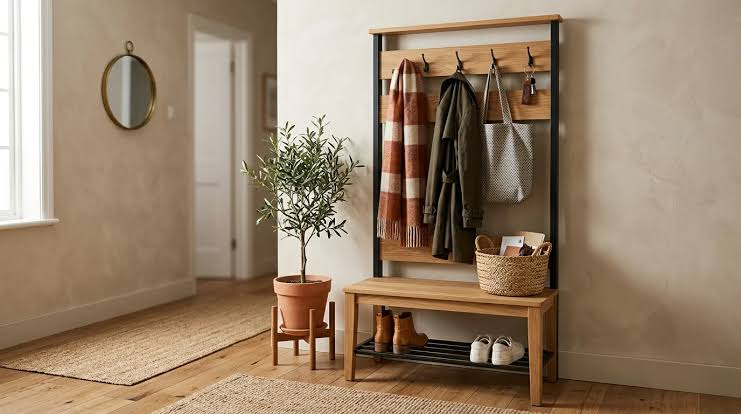
Freestanding coat stands occupy valuable floor space and may become unstable when overloaded. A wall-mounted peg rail provides similar storage while keeping the floor clear.
Install hooks at different heights. Adult coats and bags can hang higher, while children’s jackets or frequently used items can be placed lower.
Do not crowd every hook. Heavy coats extend significantly into the hallway, even when the hooks themselves are shallow. Keep only current-season outerwear in the entryway and store less frequently used items elsewhere.
A wooden peg rail introduces warmth, while black metal hooks create a cleaner contemporary appearance. Painting the rail in the wall colour can help it blend into a very small space.
Use a Tilt-Out Shoe Cabinet
Shoes are often the biggest storage challenge in a narrow entryway. Standard shoe racks can be too deep, but tilt-out cabinets store footwear at an angle and usually have a slimmer profile.
Wall-mounted versions keep the floor visible, making the entrance feel more open. The top can act as a narrow surface for keys or a small decorative object.
Before buying a tilt-out cabinet, check whether it can accommodate the types of shoes used in the household. Large boots, high heels, and bulky trainers may not fit comfortably in very shallow compartments.
Secure tall or wall-mounted cabinets according to the manufacturer’s instructions. Entryway storage is opened frequently, so stability is essential.
Turn the Back of the Door Into Storage
The back of the entrance door can hold lightweight items without using wall or floor space. Over-door hooks are suitable for scarves, umbrellas, reusable bags, and light jackets.
A fabric or clear-pocket organiser can store smaller accessories, although it should not interfere with the door handle, lock, hinges, or closing mechanism.
Avoid loading the door with excessive weight. Heavy storage may affect alignment or make the door difficult to operate. Any installation must also preserve the door’s safety and security functions.
This approach is especially useful in rented homes because many over-door systems require no drilling.
Create a Full-Height Storage Column
When width is limited, use height. A tall, narrow storage column can occupy a small footprint while providing several types of organisation.
The lower section can hold shoes, the middle section can contain hooks or shelves, and the upper section can store seasonal items. Closed doors reduce visual clutter, while open sections keep everyday belongings accessible.
A full-height unit should be fixed securely to the wall. Paint it the same colour as the surrounding wall to reduce its visual weight.
Do not make every compartment equally sized. Design the internal layout around the actual items you need to store.
Fit Shelves Into Unused Recesses
Small recesses beside doors, structural columns, or staircase walls are often too narrow for standard furniture but suitable for custom shelves.
Made-to-measure shelves can use the full width of the recess without projecting into the walkway. Open shelves work well for baskets, shoes, and decorative objects, while a fitted door creates a cleaner appearance.
If the recess is irregular, adjustable shelving allows the storage to change over time. Use matching containers to organise small items and prevent open shelving from looking untidy.
Paint the inside of the recess in a contrasting shade if you want it to become a feature. Use the wall colour if you prefer the storage to appear integrated.
Install an Overhead Shelf
The wall above the entrance door is rarely used, yet it can provide storage for lightweight or seasonal items. A high shelf can hold labelled boxes, hats, spare bags, or occasional accessories.
Keep the shelf shallow enough to avoid making the entryway feel oppressive. It should be installed securely and positioned so objects cannot fall when the door moves.
Use attractive matching boxes because the contents will remain visible from below. Alternatively, fit closed overhead cupboards for a more streamlined appearance.
Only store items that can be accessed safely. If reaching the shelf requires an unstable chair or awkward movement, it will not function well in daily life.
Add a Fold-Down Entryway Surface
A fold-down shelf provides a temporary surface without permanently reducing the walkway. It can be opened when sorting mail, placing a bag down, or preparing to leave the house.
When closed, the unit sits almost flat against the wall. Some designs include a mirror, small internal compartments, or hooks.
This solution is useful when even a shallow fixed console would be intrusive. However, the shelf must not open into the path of the entrance door.
Use secure fixings and respect the unit’s weight limit. A fold-down surface is appropriate for small objects, not for sitting or holding heavy bags unless specifically designed for that purpose.
Build Storage Around a Mirror
A mirror is useful in an entryway, but it can also contribute to storage. Choose a shallow mirrored cabinet, a mirror with a shelf, or a design with concealed hooks.
Mirrors reflect light and can make a narrow entrance feel wider. Position the mirror where it does not reflect visible clutter from another room.
A full-length mirror with a small shelf can create a practical dressing point. A mirrored door on a shallow cabinet hides storage while maintaining a clean appearance.
Avoid large leaning mirrors in very tight entrances. A properly secured wall-mounted design is safer and occupies less floor space.
Use Baskets Without Creating Clutter
Baskets can organise gloves, scarves, pet accessories, and reusable shopping bags, but too many visible baskets may make a narrow hallway look busy.
Use one basket per category and label it where helpful. Select containers that fit shelves exactly rather than leaving unused gaps.
Wall-mounted wire baskets are suitable for lightweight everyday items. Fabric baskets soften the interior, while rigid boxes create a structured appearance.
Avoid open floor baskets in the main walking route. They can quickly become obstacles, particularly when shoes and bags are placed around them.
Convert the Lowest Stair Area Into Entryway Storage
If the narrow entrance is beside a staircase, the lower under-stair section may provide storage that standard furniture cannot.
Possible solutions include:
- Pull-out shoe drawers
- Fitted coat cupboards
- Open cubbies
- A small pet station
- Sliding storage compartments
- A recessed bench
- Closed household storage
Custom under-stair joinery can follow the changing height and depth of the staircase. Although it may cost more than freestanding furniture, it can use otherwise wasted space efficiently.
Structural, electrical, and ventilation requirements should be checked before altering an under-stair area.
Create a Standing Shoe-Changing Point
A full bench may be impossible in a very narrow entryway. Instead, install a small wall-mounted perch, folding seat, or compact corner stool where space permits.
Combine it with a wall handle or stable surface for support. A folding seat can remain closed when not in use, preserving the walkway.
If no seating can fit safely, provide a low ledge for temporarily resting a foot while tying shoes. The ledge must be securely fixed and designed to bear the necessary load.
Avoid adding a small stool simply because it fits. If it needs to be moved every time someone enters, it is not a practical storage solution.
Divide Belongings by Frequency of Use
Narrow entryways become cluttered when they are expected to hold every coat, shoe, and accessory owned by the household.
Organise items into three groups:
Daily Items
Keep everyday shoes, keys, bags, and current outerwear within easy reach.
Occasional Items
Store umbrellas, guest accessories, and less frequently worn footwear in higher or closed compartments.
Seasonal Items
Move out-of-season coats, sports equipment, and rarely used shoes to another storage area.
This rotation reduces the amount of physical storage required and makes the entryway easier to maintain.
Design Recipes for Different Types of Narrow Entrances
The Almost-Nonexistent Entryway
Install a mirror with a narrow shelf, three wall hooks, and one small wall basket. Add a washable runner to define the entrance without adding furniture.
The Long Corridor Entrance
Use a wall-mounted tilt-out shoe cabinet near the door and a peg rail farther along the wall. Keep the opposite side empty to preserve a clear route.
The Rental Entryway
Choose over-door hooks, removable wall organisers, a slim freestanding shoe rack, and adhesive cable-free lighting. Confirm that removable products are suitable for the wall finish.
The Family Entryway
Assign each household member a hook and labelled basket. Use lower hooks for children and reserve upper storage for seasonal items.
The Minimalist Entryway
Install one floating drawer, a simple mirror, and concealed shoe storage. Match the cabinet and wall colours to reduce visual contrast.
Storage Mistakes That Make a Narrow Entryway Worse
The most common mistake is purchasing furniture according to its width while ignoring its depth. A narrow cabinet can still block movement if it projects too far into the hallway.
Also avoid:
- Placing storage behind the door’s swing
- Installing hooks where coats obstruct the walkway
- Leaving shoes loose on the floor
- Using unstable, tall furniture
- Filling every section of wall
- Storing heavy items overhead
- Creating surfaces that collect unnecessary objects
- Ignoring children’s access needs
- Blocking radiators, switches, or ventilation
Storage should make the entrance easier to use, not simply increase the number of objects it contains.
The Final Entryway Test
After installing storage, evaluate the entrance during a busy moment rather than when it is empty.
Can two people pass each other? Can the door open completely? Is it possible to remove a coat without hitting the wall? Are shoes accessible without blocking the walkway? Can keys be reached quickly?
If the answer to any of these questions is no, reduce or reposition the storage.
The best narrow-entryway solution is usually a combination of shallow wall-mounted storage, vertical organisation, and strict control over what remains near the door. When every item has a defined place, even an entrance that cannot fit standard furniture can become practical, welcoming, and visually organised.
Quick Answers
What is the narrowest type of entryway storage?
Hooks, peg rails, wall pockets, and very shallow floating ledges require the least depth. They are suitable where cabinets would obstruct movement.
How do you store shoes in an extremely narrow entrance?
Use a tilt-out wall-mounted cabinet, vertical shoe organiser, fitted recess, or compact rack positioned outside the main walking route.
How can renters add entryway storage?
Over-door hooks, freestanding slim racks, tension systems, removable organisers, and existing-door storage can provide capacity without permanent alterations.
Should a narrow entryway use open or closed storage?
Closed storage creates a calmer appearance, while open storage provides faster access. A combination usually works best: open hooks for daily items and closed compartments for everything else.
How can a narrow entryway look less cluttered?
Limit visible belongings, use matching containers, keep the floor clear, repeat a small colour palette, and remove out-of-season items regularly.