Small Garage Workbench Ideas With Built-In Tool Storage for Modern Home Workshops
The best small garage workbench is not the biggest bench you can fit in the room. It is a compact, sturdy surface with built-in tool storage that keeps your most-used tools visible, your worktop clear, and enough floor space left to walk around — and, in many garages, to park a car as well. In practice, that usually means a bench about 48 to 72 inches long and 24 to 36 inches deep, with drawers, shelves, a pegboard, or a rolling chest built into the design.
This guide covers the layouts that work best in a tight garage, how to size a bench around parking and clearance, and how to organise storage so every tool goes back to the same place. Whether you build, buy, or adapt a bench, the goal is a modern home workshop that is ready to use in minutes.
What a Small Garage Workbench With Built-In Tool Storage Should Actually Do for You
A good small workbench does three jobs at once. It gives you a flat, stable surface at a comfortable height — typically around 34 to 36 inches for standing work. It stores the tools you reach for most, close to where you use them. And it stops the rest of the garage from creeping onto the worktop: when every tool has a home in or above the bench, the top stays a workspace instead of becoming another shelf.
That is why built-in storage matters more than bench size. A long bench with no storage quickly collects boxes and half-finished projects, while a shorter bench with shallow drawers, a lower shelf, and a pegboard above it can hold just as much and stay usable. List the tools you use weekly first; those decide how many drawers, hooks, and shelves you need. Everything else can live in a cabinet or on a higher shelf.
- Daily tools: pegboard, magnetic strip, or top drawer, within arm's reach of the bench.
- Weekly tools: bench drawers or lower shelf, labelled so anyone can find them.
- Rarely used tools: closed cabinets or overhead storage, out of the working zone.
Sizing Your Small Garage Workbench So Parking, Walking and Working Still Fit
Measure before you buy or build: the wall, the parking space, and the swing of every door. In a garage that still parks a car, leave room to open the car doors and walk around the vehicle without brushing the bench. A bench along the back wall often works better than one along a side wall, because it does not narrow the parking bay. In a single-car garage, a 48-inch bench is often the sweet spot.
Depth matters as much as length. A bench 24 inches deep keeps tools at the back within reach and leaves more aisle space, while a 30- to 36-inch-deep bench suits larger assembly work but eats into walking room fast. Also check lighting and headroom: you need clear space above the bench for a pegboard and a light, and room to step back and carry a board without hitting a garage door track.
Treat these as starting points. Your height, your projects, and your door clearances should shape the final size.
Five Small Garage Workbench Layouts With Built-In Tool Storage That Earn Their Floor Space
The right layout depends on whether you park in the garage, how often you work there, and whether the bench needs to move. These five cover most small garages.
A Fold-Down Wall Bench for Garages That Still Need to Park
A wall-mounted folding bench hinges down when you need it and folds flat against the wall when you do not, freeing the floor for parking. Use heavy-duty brackets and a latch that locks the top in both positions, and anchor the wall rail firmly into studs — drywall fixings alone will not hold a loaded bench. Keep tools on the pegboard above, so they stay put when the top is folded up.
A Fixed Drawer Bench for Everyday Home Workshop Use
If you have a dedicated workshop corner, a fixed bench with built-in drawers is hard to beat. Shallow top drawers suit wrenches, screwdrivers, and measuring tools; deeper drawers hold power tools and chargers, while a lower shelf takes toolboxes and bulky items. Add dividers or foam inserts so tools do not slide into a pile, and label each drawer until the layout becomes habit.
A Mobile Bench on Locking Casters for Tight, Multi-Use Garages
A mobile bench can be rolled to the centre of the garage for a big job, pushed against a wall for parking, or moved beside a car for repair work. Always lock all casters before you start, and choose casters rated for the bench plus its tools and projects. A rolling tool chest underneath gives you deep, organised storage that moves with the bench — ideal if the garage layout changes often.
A Corner Workbench That Turns Dead Space Into Tool Storage
Corners are often wasted in garages, yet an L-shaped corner bench gives you a long working surface without jutting far into the room. Use one leg for detailed work and the other for assembly, and fit shelves or a cabinet into the corner underneath. Put your most-used tools along the straight runs, where you can see them, and reserve the hard-to-reach corner for items you need less often.
A Bench-and-Cabinet Wall for a Tidy Modern Home Workshop
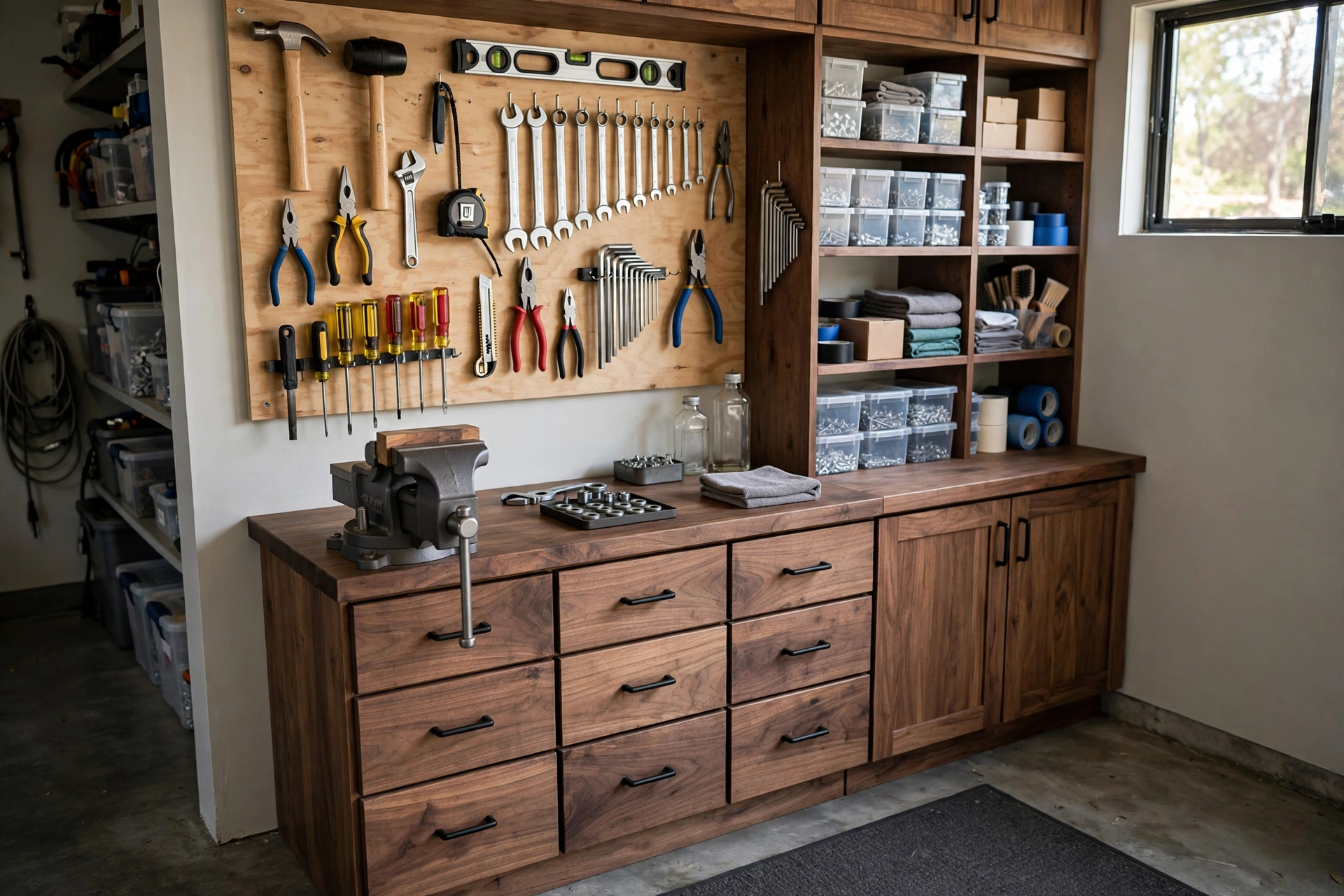
For a cleaner, more finished look, pair a bench with tall, slim cabinets on either side and a pegboard or shelf above. Closed cabinets hide bulkier gear and supplies that would otherwise clutter the bench, while the open bench zone stays for active work. This layout takes more wall space, but it is the easiest to keep tidy long-term, because everything has a door to close behind it.
Building Your Workbench Tool Storage Around Pegboard, Drawers and Magnetic Strips
The most useful storage is what you can see and reach without thinking. Pegboard above the bench puts hand tools on display: group similar tools together so a missing tool is obvious at a glance. Magnetic strips suit metal hand tools such as wrenches, pliers, and screwdrivers, and take up almost no space. French cleats — angled wooden strips fixed to the wall — are a flexible alternative, letting you move holders, bins, and small shelves as your collection changes.
Drawers and shelves handle what pegboard cannot. Use shallow drawers for small hand tools and fasteners, with small-parts organisers or labelled jars for screws, nails, and wall plugs. Keep power tools on a lower shelf or in a deep drawer with batteries and chargers nearby. A simple test helps: if you must move three things to reach a tool, that tool is stored in the wrong place.
Choosing Workbench Materials, Tops and Casters for a Modern Home Workshop
For most home workshops, a plywood or hardwood top over a sturdy timber or steel frame offers the best balance of cost, strength, and repairability. A thicker top — around an inch or more — resists dents, and a replaceable hardboard layer on top takes saw cuts, glue, and paint. Steel frames suit heavier work and damp garages; timber frames are easier to build and adapt.
Do not economise on casters for a mobile bench. Look for locking casters with a sensible weight rating, wheels that roll smoothly on concrete, and a foot-operated brake. For a fixed bench, level the feet so the top does not rock on an uneven garage floor. A sealed or painted top is easier to wipe clean than raw timber, and lighter wall colours with good task lighting make a small garage feel larger and safer to work in.
Keeping a Small Garage Workbench Safe, Lit and Easy to Work At, and Knowing When to Call a Professional
Safety starts with the basics: a clear floor, a stable bench, and good light. Keep walkways free of cords, offcuts, and toolboxes, store sharp tools with blades covered, and add a bright task light over the bench, since shadows cause slips and poor cuts. Keep a first-aid kit and a fire extinguisher within reach, not buried behind storage. Follow power-tool instructions, wear eye and hearing protection where needed, and never remove guards to make a cut easier.
Some jobs belong to a professional. Call a qualified electrician for new circuits or garage wiring beyond a like-for-like replacement, and a qualified professional for structural changes or gas work. If a wall looks damaged or damp, get advice before loading a wall-fixed bench heavily. If a bench wobbles or pulls away from the wall, stop heavy work until it is fixed properly.
A Step-by-Step Weekend Plan for Setting Up Your Small Garage Workbench
- Clear the wall and floor, then mark parking, door swings, and the walking route with tape.
- Choose a bench length and depth that leaves a comfortable aisle and door clearance.
- Fix the pegboard, shelf, or tool rail first, at a height you can reach without stretching.
- Build or position the bench, level it, anchor it if wall-mounted, and test it for wobble.
- Sort tools into daily, weekly, and rarely used groups, then assign each a home.
- Label drawers and bins, then adjust the layout after a week of real use.
Do not aim for perfect organisation on day one. Use the bench for a week, notice which tools you hunt for, and move those tools closer. The best layout is the one that survives real projects, not the one that looks tidiest in a photograph.
Final Thoughts: A Small Garage Workbench That Keeps Tools Ready and the Top Clear
A small garage does not need a large workbench; it needs a smart one. Choose a size that fits your parking and walking space, build storage into the bench and the wall above it, and give every tool a visible, reachable home. Keep the top clear for the job in hand, and add a five-minute end-of-job reset — tools back on hooks, fasteners back in jars, offcuts cleared — so the bench stays tidy after the first month.
Garage Workbench Tool Storage Questions Homeowners Ask Most
How big should a small garage workbench be?
About 48 inches long and 24 inches deep suits many small garages, while 60 to 72 inches long and 24 to 30 inches deep suits a larger workshop wall. Height is usually 34 to 36 inches for standing work. Check parking, door swings, and aisle space first.
Is a folding workbench strong enough for real workshop jobs?
A well-built folding bench anchored into wall studs handles light to medium work, including repairs and assembly. Check the weight rating, lock the supports fully before use, and avoid heavy hammering on a lightweight folding top.
What is the best tool storage for a small garage workbench?
A mix works best: pegboard above the bench for daily hand tools, shallow drawers for small tools and fasteners, and a lower shelf or rolling chest for power tools. Magnetic strips are a useful addition for metal hand tools.
Should my garage workbench be fixed or on wheels?
Choose a fixed bench for a dedicated workshop corner and maximum stability. Choose a mobile bench on locking casters if you park in the garage or often move the bench for larger jobs. Lock every caster before you start work.
How do I keep a workbench top clear in a small garage?
Give every tool a home away from the top — pegboard, drawer, or shelf — and reset the bench for five minutes at the end of each job. If the top keeps filling up, you likely need more wall storage, not a bigger bench.
Do I need a vise on a small garage workbench?
Not necessarily. A vise holds work steady but takes space and adds weight to the front edge. If you fit one, mount it solidly to a thick top near a strong frame joint, and leave clearance to work around it.
How much does a small garage workbench with storage cost?
Costs vary widely with size, materials, and whether you build or buy. As a broad estimate, a simple DIY timber bench with basic storage is a modest weekend project, while a ready-made steel bench with drawers or a rolling chest costs considerably more. Compare the storage included, not just bench size.