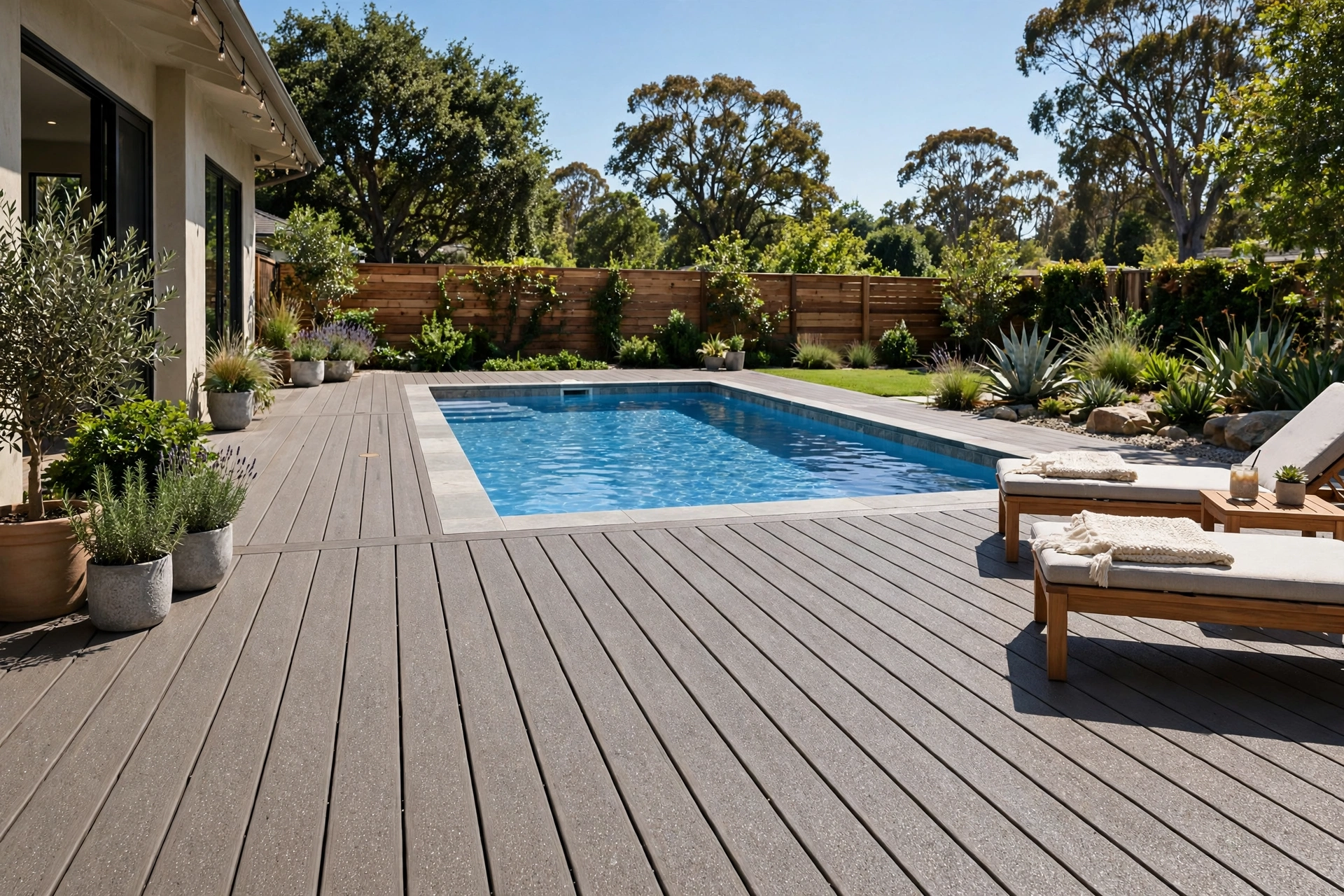
Outdoor Pool Deck Materials That Provide Slip Resistance and Long-Term Durability
A pool deck is walked on barefoot, soaking wet, and often by children running when they should be walking. That combination makes it one of the few surfaces in a home where a wrong material choice is not just a maintenance nuisance, but a genuine safety problem. The best pool deck material is therefore not simply the most attractive one in a showroom, where it is dry and clean. It is the one that still grips wet feet after years of sun, chlorine, and salt, and that does not crack, shift, or become dangerously hot underfoot.
The direct answer is that textured concrete pavers and slip-rated porcelain pavers are the strongest all-round choices for most homes, with light-coloured natural stone close behind for a premium finish. Poured concrete can work well when it is correctly textured, while smooth, polished stone and heavily sealed surfaces should be avoided around a pool, because they become slippery when wet. Colour matters almost as much as material: light surfaces stay cooler, dark surfaces absorb far more heat, and that difference is felt immediately on bare feet in summer.
This guide compares the main pool deck materials on the four factors that matter most: wet slip resistance, heat underfoot, durability in pool chemicals and weather, and long-term maintenance. It also explains how installation, drainage, and sealing change those results, because even a good material performs poorly when it is laid flat, sealed incorrectly, or allowed to settle unevenly.
Why Pool Deck Slip Resistance Is Measured Differently From Ordinary Paving
Slip resistance around a pool is not about how a surface feels when dry. A surface that feels rough dry can still be slick when a thin film of water, sunscreen, or algae sits on it, and a surface that grips well when new can lose grip as its texture wears or as a sealer fills its pores. That is why product data sheets matter: look for a wet slip rating from a recognised test method, and ask the supplier for that rating in writing for the exact finish you are buying, not for a different finish in the same range.
Texture is what creates grip, and it comes in different forms. Broom-finished and exposed-aggregate concrete, textured pavers, honed rather than polished stone, grooved timber, and slip-rated porcelain all provide small ridges or pores that break up the water film underfoot. Smooth, polished, or glassy surfaces do the opposite: they allow water to form a continuous film, and a bare foot can slide across it with very little warning. If a sample feels glassy when dry, it will almost certainly be worse when wet.
Poured Concrete Pool Decks: Affordable, Repairable, and Only as Safe as Their Finish
Poured concrete is often the lowest-cost pool deck option, and it has real advantages: it can be shaped to any pool outline, it is durable when correctly reinforced and jointed, and damaged sections can be repaired or resurfaced. Its safety, however, depends entirely on its finish. A broom finish, an exposed-aggregate finish, or a textured stamp gives wet feet something to grip, while a smooth trowelled finish, or a heavy clear sealer applied over a smooth surface, can turn an otherwise sound deck into a slip hazard.
Concrete also expands and contracts with temperature, so control joints are essential. Without them, cracks appear in unpredictable places and can become trip hazards as edges lift. A light colour helps with heat, because concrete absorbs a large share of sunlight, and dark concrete in full sun can become uncomfortable for bare feet by mid-afternoon. Sealing, when used, should be a penetrating sealer that does not form a glossy film, and it should be reapplied on the manufacturer’s schedule rather than left until the surface begins to deteriorate.
Concrete and Porcelain Pavers for Pool Surrounds That Stay Grippy and Repairable
Pavers are individual units laid on a compacted base with sand joints, and that construction gives them two advantages over a single poured slab. First, each paver can be textured during manufacture, so slip resistance is built into the unit rather than relying on a finish applied on site. Second, a single damaged, stained, or settled paver can be lifted and replaced without breaking up a whole section, which makes long-term repair far easier and cheaper.
Concrete pavers are widely available, come in many colours and shapes, and perform well when they are textured and correctly jointed. Porcelain pavers, usually in a thicker outdoor format, are denser and less porous, so they resist staining from pool chemicals, resist frost damage, and generally need less sealing. The critical check for porcelain is its slip rating: only buy a product that is specifically rated for wet outdoor and pool use, because a porcelain tile designed for indoor floors can look identical and perform dangerously around a pool.
Natural Stone Pool Decks: Travertine, Limestone, and the Finish That Changes Everything
Natural stone, especially light travertine and limestone, is popular around pools for good reasons: it looks natural, it stays relatively cool underfoot when light in colour, and a honed or tumbled finish provides good wet grip. Stone is also heavy and durable, and it ages gracefully when it is maintained. The finish, however, changes everything. A honed finish, which is matte and slightly textured, grips well. A polished finish, which is shiny and smooth, does not, and it should not be used for a pool surround regardless of how attractive it looks in a showroom.
Porous stone needs sealing, and that sealing must be done correctly. A penetrating sealer protects against staining from leaves, sunscreen, and pool chemicals without creating a slippery film on the surface. A topical, glossy sealer can fill the texture that provides grip and should be avoided unless it is specifically designed for wet pool use and includes an anti-slip additive. Re-sealing on schedule is part of owning a stone deck, and skipping it leads to staining and gradual loss of protection, even if the stone itself remains structurally sound.
Timber and Composite Pool Decking: Warm Underfoot, With Different Upkeep
Timber decking feels warm and natural underfoot and suits raised or sloping pool areas where paving would require extensive levelling. Grooved boards provide good grip, and timber does not store heat as aggressively as dark concrete. Its weakness is upkeep: timber around a pool needs regular cleaning and recoating with oil or stain, otherwise it greys, splits, and splinters, and those splinters are a particular problem for bare feet. Rot resistance also matters, so the timber species and treatment should suit constant wetting and pool chemical splash.
Composite decking, made from wood fibre and plastic or from capped polymer boards, reduces that upkeep sharply: it does not need sealing, it resists staining and pool chemicals well, and individual boards can be replaced. Its weaknesses are heat and surface film. In full sun, composite can become warm, and a dirty or algae-covered board can become slippery even though the material itself is not smooth. Light colours and heat-reflective ranges help, but they do not make a composite deck cool in the way light stone can be. Regular washing is therefore not cosmetic; it is part of keeping the deck safe.
Pool Deck Drainage, Falls, and Edge Details That Prevent Falls and Flooding
A pool deck should fall gently away from the pool, so splash-out and rainwater drain off the surface instead of pooling on it or running back into the pool. Standing water is a slip risk, a breeding ground for algae, and a cause of staining and joint washout. Drainage channels or slots at the deck edge, and a fall of roughly one to two percent away from the pool, are typical design details, but the exact fall should be set by the installer for your site and drainage system, not guessed on the day.
Edges deserve equal attention. The coping, which is the cap around the pool rim, should be rounded or bullnosed rather than sharp, and it should not overhang in a way that creates a trip edge. Steps into the pool, changes in level, and transitions between deck materials should be clearly visible and consistently surfaced, because most pool deck falls happen at a change in level that was not obvious to someone with wet feet and limited attention. Lighting at deck edges for evening use is also a safety feature, not merely decoration, and it should be planned with the deck, not added as an afterthought.
- Check the wet slip rating for the exact finish, not just the material family.
- Choose light colours for large sun-exposed areas to keep the deck walkable.
- Use a penetrating sealer on stone and concrete, never a glossy film sealer.
- Confirm the fall away from the pool and where drainage water will go.
Pool Deck Materials That Fail Early in Chlorine, Salt, and Freeze-Thaw Weather
Pool chemicals are harder on decks than ordinary rain. Chlorine and salt water splash, dry, and leave residues that can stain porous materials, corrode some metal fixings, and degrade coatings that were not designed for pool use. Porcelain and composite materials resist this well because they are largely inert. Porous stone and concrete need sealing to resist it, and unsealed or poorly sealed surfaces will stain and deteriorate faster than the same material used away from a pool.
Final Thoughts: Choosing a Pool Deck That Is Safe Wet, Cool, and Still Good in Ten Years
The safest pool deck is rarely the smoothest or the cheapest per square metre. It is a light-coloured, textured surface with a verified wet slip rating, a fall away from the pool, and a maintenance routine you will actually follow. Textured pavers or slip-rated porcelain suit most homes, light honed stone suits a premium budget with regular sealing, and composite suits raised decks where low upkeep matters most. Whatever you choose, test a wet sample barefoot before committing, and keep the product rating and sealer schedule with your home records. A deck that is safe on the day it is laid should still be safe ten years later, and that is the real test of a good choice.
Outdoor Pool Deck Material FAQs
What slip rating should I ask for on a pool deck?
Ask for a wet slip rating for the exact finish you are buying, from a recognised test method, and get it in writing. Aim for the higher-grip end of the scale for pool surrounds, because the surface will be wet and walked on barefoot, often by children. A rating for a different finish in the same range is not a substitute.
Is porcelain safe around a pool?
Only if it is specifically rated for wet outdoor and pool use. Slip-rated outdoor porcelain pavers provide excellent grip, resist chemicals, and need little sealing. Indoor porcelain tiles can look identical but may be dangerously slippery when wet, so the rating, not the appearance, is the deciding factor.
Why does my pool deck feel hotter than my neighbour’s?
Colour is usually the main reason, followed by material. Light surfaces reflect more sunlight and stay cooler, while dark surfaces absorb most of it and become hot underfoot. A light porcelain or light stone deck will usually feel cooler than a dark concrete deck in the same sun, even when both are correctly installed.
Can I seal a pool deck to make it safer?
Sealing alone does not make a smooth deck safe. A penetrating sealer protects porous materials without creating a glossy film, which is the right approach. A glossy topical sealer can actually reduce grip by filling surface texture, so avoid it unless it is specifically designed for wet pool use with an anti-slip additive.
How often should a pool deck be cleaned?
Clean it regularly enough to prevent algae and dirt film, which reduce grip even on textured surfaces. Frequency depends on shade, leaves, and use, but a routine wash and a check of joints, coping, and drainage is a sensible seasonal habit. If a section feels slick when wet, clean it first before assuming the material itself has failed.
Should pool deck pavers be laid on concrete or compacted base?
Both methods are used, and the right choice depends on your soil, climate, and installer. A compacted aggregate base with edge restraint is common and allows individual pavers to be replaced easily. A concrete base can suit areas with unstable soil, but it changes drainage and repair methods, so discuss the trade-offs with your installer before work begins.