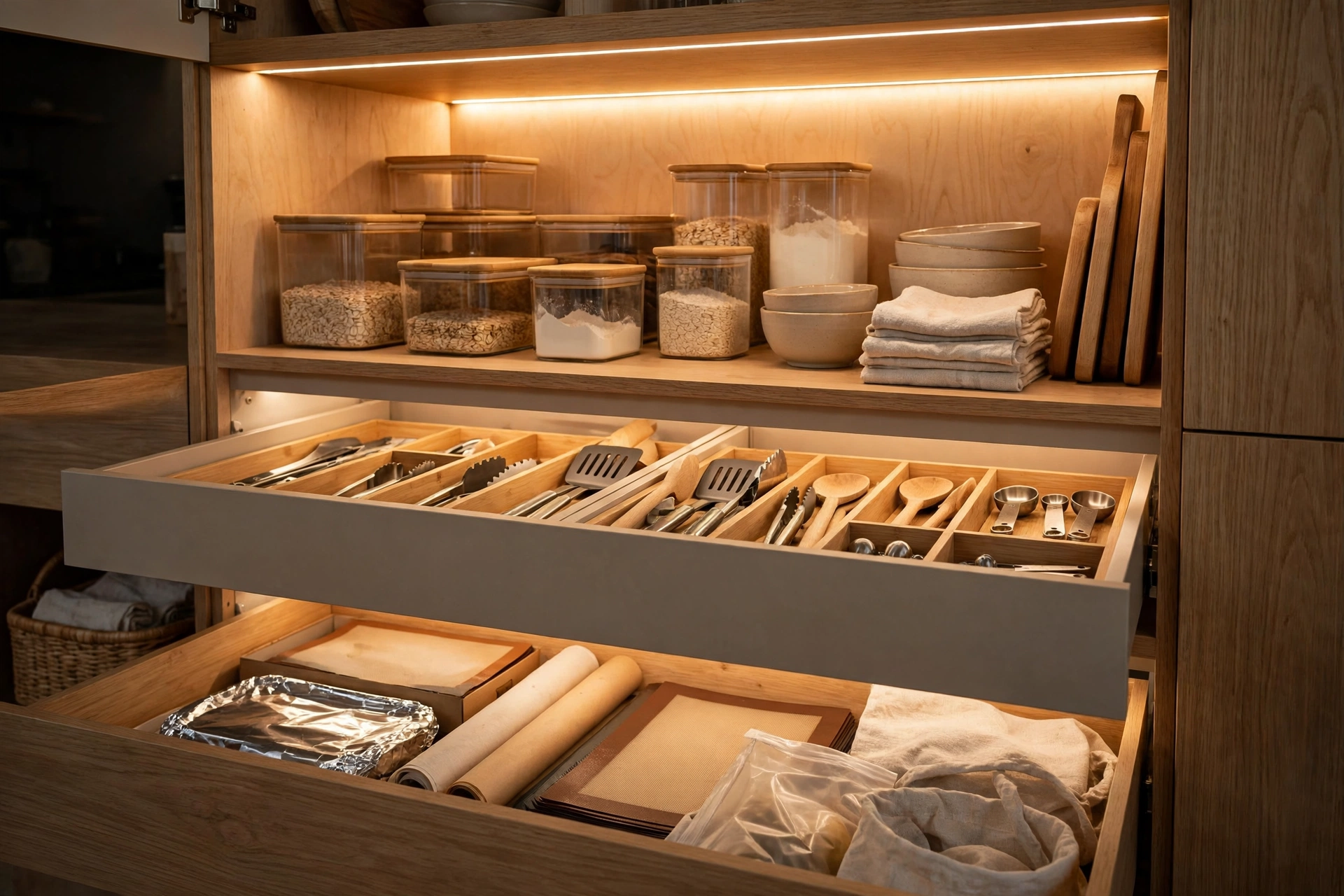
Kitchen Cabinet Lighting Upgrades That Improve Visibility Inside Deep Drawers and Hard-to-Reach Storage Areas
Deep kitchen drawers are where good intentions go dark. The pots are in there somewhere, the baking trays are stacked three deep, and the spice jars at the back have not been seen since last winter. Overhead lights cannot help, because your own body blocks them the moment you stand at the counter, and the drawer box shades everything below its rim.
- In short: The direct answer: the fix is light placed inside the storage itself, not brighter light above it. A slim LED bar or strip mounted inside a drawer or cabinet, switched on automatically when it opens, turns a blind box into a visible one. Battery and rechargeable stick-on bars do this in minutes with no wiring, while hardwired strips are the neater long-term answer during a renovation.
Why Deep Drawers Swallow Light Even in a Bright Kitchen
A kitchen can be flooded with daylight and still have pitch-black drawers, and the reason is geometry rather than brightness. A deep drawer is a box with tall sides, and light must travel down into it at an angle. Ceiling fixtures sit behind you while you work, so your torso and head cast a shadow straight into the open drawer, and upper cabinets add a second shadow over the lower cabinets. Depth makes it worse: a standard base drawer is roughly 500 millimetres deep, so items at the back sit far from the opening and light falls off quickly with distance. Dark drawer interiors absorb what little light arrives, which is why a brighter ceiling light mostly lights the top of your head, while under-cabinet strips shine onto the counter, not into the drawer below it.
Five Ways to Light a Cabinet Interior, From Stick-On Bars to Hardwired Strips
There is no single best cabinet light, because drawers, tall pantries, and corner cabinets behave differently. Most homes end up mixing two or three of these options.
- Battery stick-on bars: slim LED bars with adhesive or magnetic mounts and a motion or door sensor. Best for rented homes and for testing drawer lighting before committing to wiring.
- Rechargeable USB bars: the same idea with a built-in battery you recharge every few weeks. The most popular choice for deep drawers, since the bar lifts off its magnetic mount for charging.
- Hardwired LED strips: low-voltage strips wired to a driver, usually switched by a door sensor or wall switch. The neatest permanent result, and the right choice during a kitchen refit.
- Puck lights: small round discs, battery or wired, that throw a pool of light downwards. Useful in tall cabinets and pantries where one bar would leave the top shelf dark.
- Toe-kick lighting: strips hidden under base cabinets that wash light across the floor. They do not light drawer interiors, but they stop the lower kitchen feeling like a cave at night.
Sensor choice matters as much as the light. PIR motion sensors switch off after a short delay without movement, which suits pantry doors. Door and drawer sensors, which trigger on opening, are better inside drawers, because an open but still drawer will not keep a motion sensor awake. Many rechargeable bars offer auto, always-on, and off modes, and auto is the setting most households live with.
Battery, Rechargeable, or Hardwired: Picking the Power Source Your Cabinets Can Live With
Power source determines maintenance, so it deserves more thought than brightness. Battery bars using AAA cells are cheapest and simplest, but a busy drawer can eat through cells in weeks, and dead batteries are the number one reason drawer lights end up abandoned. Rechargeable bars cost more up front, yet most run for several weeks on a charge in sensor mode, and lifting a magnetic bar off to charge it takes seconds. Hardwired strips have no batteries at all, making them the only genuinely fit-and-forget option, but they need a driver, a cable route, and usually an electrician, so they make most sense during a renovation. A sensible middle path is to start with rechargeable bars in the two or three drawers you open most, and reserve hardwired strips for later. One warning: never put a mains socket inside a drawer. Drawer boxes move, cables chafe, and mains fittings belong fixed to the cabinet carcass, never to the moving drawer.
Where Exactly to Stick the Light Inside a Deep Drawer
Placement decides whether the upgrade works or merely glows. The goal is even light across the drawer floor with no hard shadows from dividers. Mounting the bar on the inside of the drawer front looks tidy but lights only the front few centimetres.
Before sticking anything permanently, test the position. Hold the bar with painter's tape, load the drawer as normal, and open it in the evening. If dividers throw long shadows, move the bar a few centimetres towards the centre. Five minutes of testing beats a bar that lights only the potato peeler.
Colour Temperature and Brightness That Make Food and Utensils Look Right
Colour temperature, measured in kelvin, decides whether a kitchen looks warm or clinical. For drawer and cabinet interiors, the sweet spot is warm-to-neutral white, roughly 3000K to 4000K. Warmer light flatters wood and food, while neutral white renders labels accurately, which is what you want when hunting for a spice jar. Cool white above 5000K feels like a workshop and is best avoided inside cabinets. Brightness is simpler than packaging suggests: a bar producing roughly 100 to 200 lumens is plenty for one drawer, since light travels only a short distance, and a tall pantry benefits from a brighter strip or two pucks. Dimmable bars are worth the small premium, because the brightness that feels right at midnight is not the brightness you want while cooking. Also check colour rendering: an index (CRI) of 80 or above keeps food and labels looking natural rather than washed out.
A Weekend Fitting Sequence for Battery and Rechargeable Drawer Lights
Fitting stick-on drawer lights is a small job. Allow an hour for the first drawer and half that for each one after it.
- Empty the drawer and wipe the mounting surface dry. Adhesive fails on greasy or dusty surfaces, and kitchen drawers are rarely clean inside.
- Measure the interior and choose a bar leaving a couple of centimetres clear at each end, so it does not foul the runners or dividers.
- Test the position with painter's tape and a normal load, checking the sensor triggers on opening and switches off on closing.
- Fix the mount with adhesive or screws. Screws hold better on textured surfaces, but check the length cannot poke through the drawer side.
- Charge the bar fully before first use if rechargeable, set it to auto mode, and open and close the drawer a few times to confirm the sensor.
- Reload, putting the tallest items away from the bar so they do not cast the longest shadows.
If a bar keeps falling off, the cause is almost always surface preparation or temperature. Adhesive grips poorly below about 15 degrees, so warm the surface with a hair dryer on low before sticking, and leave the bond undisturbed for a day before loading the drawer heavily.
Drawer Light Slip-Ups That Leave Batteries Dead and Drawers Still Dark
Most drawer lighting disappointments are installation errors, not product failures. The first is sensor placement: a motion sensor buried behind tall jars cannot see movement, so the light never triggers, while a sensor facing the kitchen stays on all day and drains the battery. Aim the sensor at the opening, not at the room. The second is fitting the light to a moving drawer that slides under a fixed cabinet: in tight clearances, a bar on top of the drawer box gets knocked off within a week, so mount it to the fixed cabinet above instead. The third is ignoring steam and heat: bars above a kettle or beside a hob live in a hostile environment, so keep lights away from direct steam paths and never fit a battery light where the manufacturer forbids it. Finally, resist lighting every drawer at once. Light the three or four you open daily first, live with them for a month, and only then decide whether the rest are worth doing.
What Cabinet and Drawer Lighting Tends to Cost, in Rough Terms
Costs vary by region and brand, so treat every figure here as a broad estimate rather than a quote. Drawer lighting is one of the cheapest kitchen upgrades with a daily payoff.
For most households the sensible budget is small: two or three rechargeable bars for the busiest drawers as a trial, before spending anything on wiring. If the trial changes how the kitchen feels, a hardwired scheme during the next renovation becomes an easy decision rather than a gamble.
When Cabinet Lighting Stops Being a Stick-On Job and Needs an Electrician
Battery and rechargeable lights are safe DIY territory, but hardwired work is not. Any job involving a new mains spur, a driver wired into a lighting circuit, or cables chased into walls should be done by a qualified electrician, and in many regions such work must comply with local electrical regulations and be certified. If you plan to cut cabinet backs to route cables, check whether that affects a warranty. Also stop and fix leaks, water damage, or mould before fitting any electrical item inside a cabinet, and check temperature limits for drawers above a hob or beside an oven: heat degrades batteries and adhesive alike, and a swollen lithium battery should be removed and disposed of safely, never forced back into service.
Cabinet and Drawer Lighting Questions Homeowners Ask Before Buying
Do drawer lights work in drawers that slide under a fixed cabinet?
Yes, if the light is mounted where nothing rubs against it. If clearance is tight, mount the bar to the fixed cabinet above the drawer rather than to the drawer box itself.
Will a motion sensor light stay on while I am rummaging in a drawer?
Not always. PIR sensors switch off after a short delay without movement, so drawer-open sensors or bars with an always-on mode suit deep drawers better.
Are rechargeable drawer lights worth the extra cost over battery ones?
For drawers you open daily, yes. The higher price is usually recovered within a year or two of avoided battery purchases, and a magnetic bar that lifts off for charging beats fishing dead cells out of a drawer.
What colour light looks best inside kitchen cabinets?
Warm-to-neutral white, around 3000K to 4000K. It keeps wood tones warm and labels readable, while very cool white can make food look unappetising.
Can I fit cabinet lights myself, or do I need an electrician?
Battery and rechargeable stick-on lights are straightforward DIY. Anything hardwired into a mains circuit should be done by a qualified electrician and meet local electrical rules.
Why does my drawer light keep falling off?
Almost always poor surface preparation, cold adhesive, or a bar mounted where the drawer fouls it. Clean and dry the surface, warm it slightly, give the bond a day to cure, and check the bar clears the runners.
Do I need to light every drawer and cabinet?
No. Start with the three or four spaces you open most, usually the cutlery drawer, the pot drawer, and the pantry. That covers the daily frustration, and the rest can wait for a renovation.
A Drawer You Can Actually See Into Changes How the Whole Kitchen Feels
Cabinet lighting is a small upgrade with an outsized effect: no more crouching to find the baking tray, no more pulling every drawer fully open, no more buying a second jar of something you already owned. Start with one rechargeable bar in the drawer that frustrates you most, test the position before you commit, and let the result decide whether the rest of the kitchen follows. The best next step is a single trial drawer, fitted this weekend, in the evening light where its effect is easiest to judge.