Home Office Wall Storage Systems That Organize Documents and Equipment Without Crowding Small Workspaces
A small home office fails in a predictable way. The desk starts clean on Monday, and by Thursday it is carrying a stack of papers, a headset, two chargers, a notebook, and a printer cable that nobody can explain. The problem is rarely that you own too much. It is that everything you need is competing for the same flat surface, while the largest unused surface in the room, the wall, sits empty.
- The short answer: put daily-use documents in wall file pockets at arm height, small supplies on a pegboard or rail within reach of your chair, and heavier equipment on stud-anchored shelves or a slim wall cabinet. Keep the desk for active work only, and reserve anything you touch less than once a week for a higher shelf or a closed cabinet. That single rule is what stops a wall system from becoming a second, vertical junk drawer.
Before You Buy a Single Hook: Mapping What Actually Lives on Your Office Wall
Most wall-storage projects go wrong before anything is mounted, because people buy organizers first and audit their stuff second. Spend ten minutes sorting everything currently on or around your desk into four groups, and the right system almost chooses itself.
- Daily paper — invoices to pay, forms in progress, notes for this week’s projects. This needs open, visible, arm-height storage.
- Reference paper — tax records, manuals, archived project files. This needs closed or high storage you open rarely.
- Daily equipment — headset, chargers, external drive, webcam, stationery. This needs hooks, cups, or a small shelf near the desk.
- Bulky equipment — printer, scanner, backup drive, monitor accessories. This needs a sturdy shelf or cabinet, properly anchored.
Pegboards That Flex With Your Workweek, Not Against It
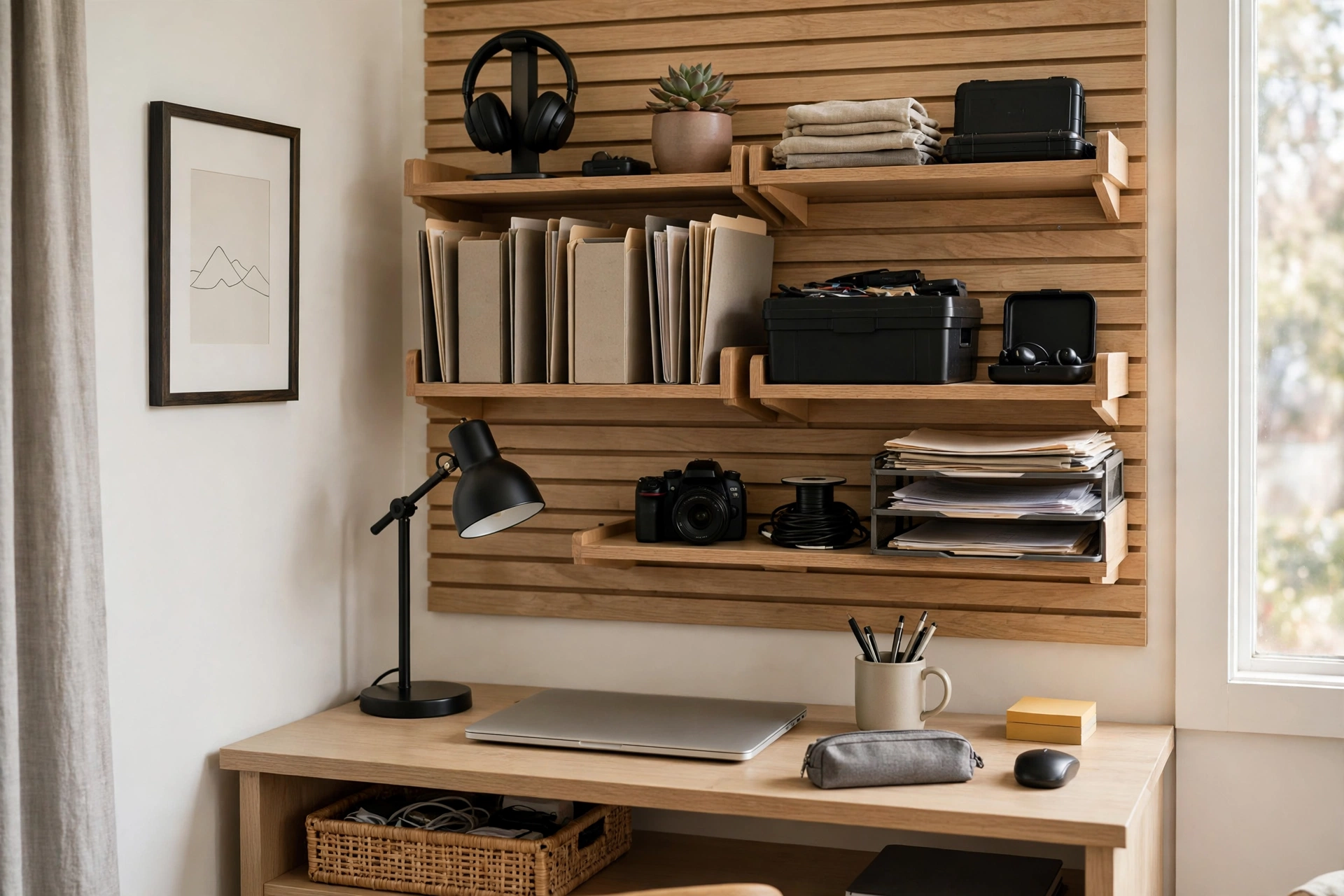
A pegboard is the most forgiving wall storage system for a small workspace, because it changes as your work changes. Hooks, cups, small shelves, and baskets rearrange in minutes without new holes, which matters when a project ends and a different kind of clutter takes its place. Mount the board at eye level beside or above the desk, with spacers behind it so hooks can seat properly, a detail beginners often skip and then wonder why hooks fall out.
Floating Shelves and Ledge Runs for Books, Binders, and Backup Gear
Floating shelves suit the things a pegboard handles badly: binders, reference books, a small speaker, a backup drive, or a plant that makes the corner feel less like a cubicle. Two shallow shelves, roughly 20 to 25 centimetres deep, above the desk hold more than one deep shelf, because shallow shelves force you to store one row deep, which means nothing hides behind anything else. Space shelves about 30 to 35 centimetres apart vertically so binders stand upright without scraping the shelf above.
Wall File Pockets and Magazine Holders: Giving Paper a Vertical Home
Paper is the quietest space thief in a home office. A stack on the desk looks small, but it spreads, and it buries the one document you need under five you do not. Wall-mounted file pockets solve this by giving each active category its own visible slot: one for incoming mail, one for this week’s work, one for bills to pay, and one for items waiting on someone else. Because the pockets are open at the top, you can see at a glance which slot is filling up, which is itself a useful warning.
Tiered pockets work best mounted beside the desk at shoulder height, where you can file a sheet without standing up. Magazine holders, mounted the same way, suit thicker items such as catalogues, notebooks, and project folders that would buckle a fabric pocket. Colour-code or label each pocket by action rather than by topic: “to pay,” “to file,” “to read,” and “waiting” are more useful than vague client names, because they tell you what to do next. Once a pocket is full, that is your signal to process it, not to buy another pocket. And keep a single rule for paper entering the office: anything that will not be needed within a month gets scanned or filed away from the desk wall entirely.
Rails, Grids, and Magnetic Strips for the Small Stuff That Vanishes
The smallest office items cause the most daily friction: pens, scissors, sticky notes, binder clips, and charging cables. They are too small for a shelf, too fiddly for a drawer, and they migrate across the desk all day. A kitchen-style rail with S-hooks and hanging cups, a wire grid panel, or a magnetic strip mounted at arm height gives each of them a fixed home that costs almost no wall area.
Rails work best in a horizontal run just above desk height, with cups for pens and small tools and hooks for scissors, a headset, or a lanyard. Wire grids suit renters and changers, because baskets and clips move around the grid without new holes. Magnetic strips are ideal for metal items such as binder clips, scissors, and small tools, and a magnetic board doubles as a place to pin notes and a calendar. The trick with all three is restraint: one rail or one grid section is enough for a small office. A second run usually means you are storing things you should have thrown away, and a wall covered in rails looks busier than the desk it replaced.
Charging Docks and Cable Channels: Keeping Equipment Powered Without a Tangle
Equipment storage fails when power is an afterthought. A headset hung neatly on a hook is not organized if its charging cable dangles across the desk, and a printer on a wall shelf is not convenient if you have to crawl behind furniture to plug it in. Plan power at the same time as storage: a small wall-mounted charging dock or a shelf with a cable channel keeps devices, chargers, and cables in one zone.
How Much Weight Your Wall Can Really Carry (and What to Anchor Into)
Wall storage only works if it stays on the wall. Published installation guidance consistently makes the same point: the fixing matters more than the shelf. A bracket screwed into a wall stud typically supports far more than the same bracket held by plasterboard anchors alone, and deep shelves create more leverage than shallow ones, so they need stronger fixings. Always check the manufacturer’s stated rating for your exact shelf and hardware, and treat published figures below as general guidance, not a guarantee for your wall.
Find studs with a stud finder and mark them before drilling, and if your wall is brick or concrete, use masonry fixings rated for that material. Load shelves to about three-quarters of their stated limit as a safety margin, keep heavy items low and near the fixings, and recheck fixings after the first month. If a shelf tilts, creaks, or a screw feels loose, unload it and refix it before it fails. For anything involving new electrical outlets or hardwired lighting, hire a licensed electrician rather than extending circuits yourself, and if you are unsure about your wall type, ask a handyperson to confirm it before you load a shelf with equipment.
A Weekend Wall-Storage Build, in Order
- Audit and sort — empty the desk, sort everything into daily paper, reference paper, daily equipment, and bulky equipment, and remove anything unused.
- Measure and mark — measure the wall, locate studs, and sketch zones for paper, supplies, and equipment, leaving one empty stretch.
- Mount the heavy items first — shelves and cabinets go up first, into studs, because their positions are hardest to change.
- Add the flexible layer — pegboard, rails, or grid panels go up next, positioned around the fixed shelves.
- Install paper storage — file pockets and magazine holders at shoulder height beside the desk, labelled by action.
- Wire the charging zone — mount the charging dock, run cables through channels, and label chargers.
- Load lightest last — fill from the bottom up, heaviest low, and leave every zone about a fifth empty for growth.
- Live with it for a week — adjust hook positions and labels after real use, then do a five-minute reset each month.
Wall-Storage Slip-Ups That Shrink a Small Office Instead of Saving It
The most common failure is overfilling. A wall system loaded to the brim looks worse than a messy desk, because it turns the whole room into storage. Leave breathing room in every zone, and treat a full pocket or shelf as a prompt to process, archive, or discard, not to expand. The second failure is height: storage mounted too high becomes dead space, because nobody reaches for it, and storage mounted too low collides with the desk chair or monitor arm. Keep daily items between seated elbow height and standing eye level, and reserve anything above that for archives.
What a Wall Storage System Costs, in Rough Terms
Home Office Wall Storage Questions Small-Workspace Owners Keep Asking
Can wall storage really replace a filing cabinet in a tiny office?
For active paperwork, yes. Wall file pockets and magazine holders handle the documents you touch weekly, which is usually the bulk of desk clutter. A filing cabinet is still better for archives, legal records, and anything you must keep for years, because closed, labelled drawers protect paper from dust and light. The practical split is simple: this month’s paper on the wall, everything older in a cabinet, a closet, or a scanned archive.
What is the best wall storage for renters who cannot drill?
Adhesive rails, command-style hooks, wire grids hung from a picture rail or door hooks, and freestanding leaning shelves that rest against the wall all work without drilling. Keep loads light, follow the adhesive manufacturer’s weight rating and surface instructions, and avoid hanging anything heavy or valuable from adhesive fixings alone. When you move out, adhesive systems also leave far less repair work than drilled shelves.
How do I stop a pegboard from looking messy?
Limit the board to one category per zone, use matching cups and hooks, and leave roughly a fifth of the board empty. A monthly five-minute reset matters more than any accessory: remove anything unused, return stray items to their zone, and wipe the board down. If the board still looks busy, you probably have too much on it, and moving archives to a closed cabinet will help more than buying tidier hooks.
Is it safe to mount a printer or monitor on a wall shelf?
A printer can sit on a sturdy, stud-mounted shelf rated for its weight plus paper, with ventilation space behind it. A monitor is better on a dedicated wall mount rated for its size and weight, rather than a general shelf, because mounts are engineered for the load and tilt. In both cases, check the manufacturer’s rating, anchor into studs or masonry, and never exceed the stated limit.
How much wall space should I leave empty?
Aim to leave at least a fifth of your planned storage wall empty, plus one completely clear stretch for visual rest. Empty space keeps the room feeling like a workspace rather than a warehouse, and it gives the system room to grow when a new project arrives. If every zone is full on day one, the system has no slack, and clutter will return to the desk within weeks.
A Small Workspace That Breathes Again: Your Next Wall to Claim
The payoff of wall storage is not tidiness for its own sake. It is a desk that stays clear through the week, documents you can find without digging, and equipment that is charged, reachable, and out of the way. Start with the audit, mount the heavy items into studs, add one flexible panel and one paper system, and wire the charging zone before you call the job done. Then live with the setup for a week, adjust what does not work, and keep the monthly five-minute reset. A small workspace does not need more room. It needs its walls put to work, one zone at a time.