Best Space-Saving Closet Systems for Narrow Bedrooms and Small Apartment Homes
A narrow bedroom leaves no room for error. The closet is usually a single reach-in box, the door swing eats into the floor, and the bedroom itself must still hold a bed, a place to dress, and a path to the door. In that setting, a closet system is not a luxury upgrade. It is the difference between a room that feels cramped because clothes spill out of it and a room that feels calm because everything has a place.
The short answer is that a modular, wall-mounted system with double hanging, adjustable shelves, and shallow drawers usually gives a narrow bedroom the most storage per inch, especially when paired with sliding or mirrored doors. Custom built-ins fit best but cost most, while basic wire systems are cheap and adjustable but less kind to folded clothes. The sections below cover measuring a narrow closet, choosing between system types, and laying out zones that keep daily clothes reachable.
Measuring a Narrow Closet Before Choosing Any System
Start with the three dimensions that decide everything: interior width, interior depth, and ceiling height, measured at several points because older closets are rarely square. Note the door opening width and type, the position of any light, vent, or sloping ceiling, and whether the closet is a reach-in, a corner, or a shallow alcove. A system that fits the catalogue photograph but not your depth will either block the door or waste the back of the closet.
Two depth rules matter most. Hanging clothes need roughly 24 inches of depth to hang without crushing against the door, while shelves for folded clothes work well at 12 to 16 inches deep. If your closet is shallower than 24 inches, hanging will always be a compromise, and a system built around shelves, drawers, and hooks may serve you better than a rod that forces the door shut against sleeves. Record these numbers before shopping, and compare them with the assembled depth of any system, not just the shelf depth.
Closet Layouts That Work in Narrow Bedrooms
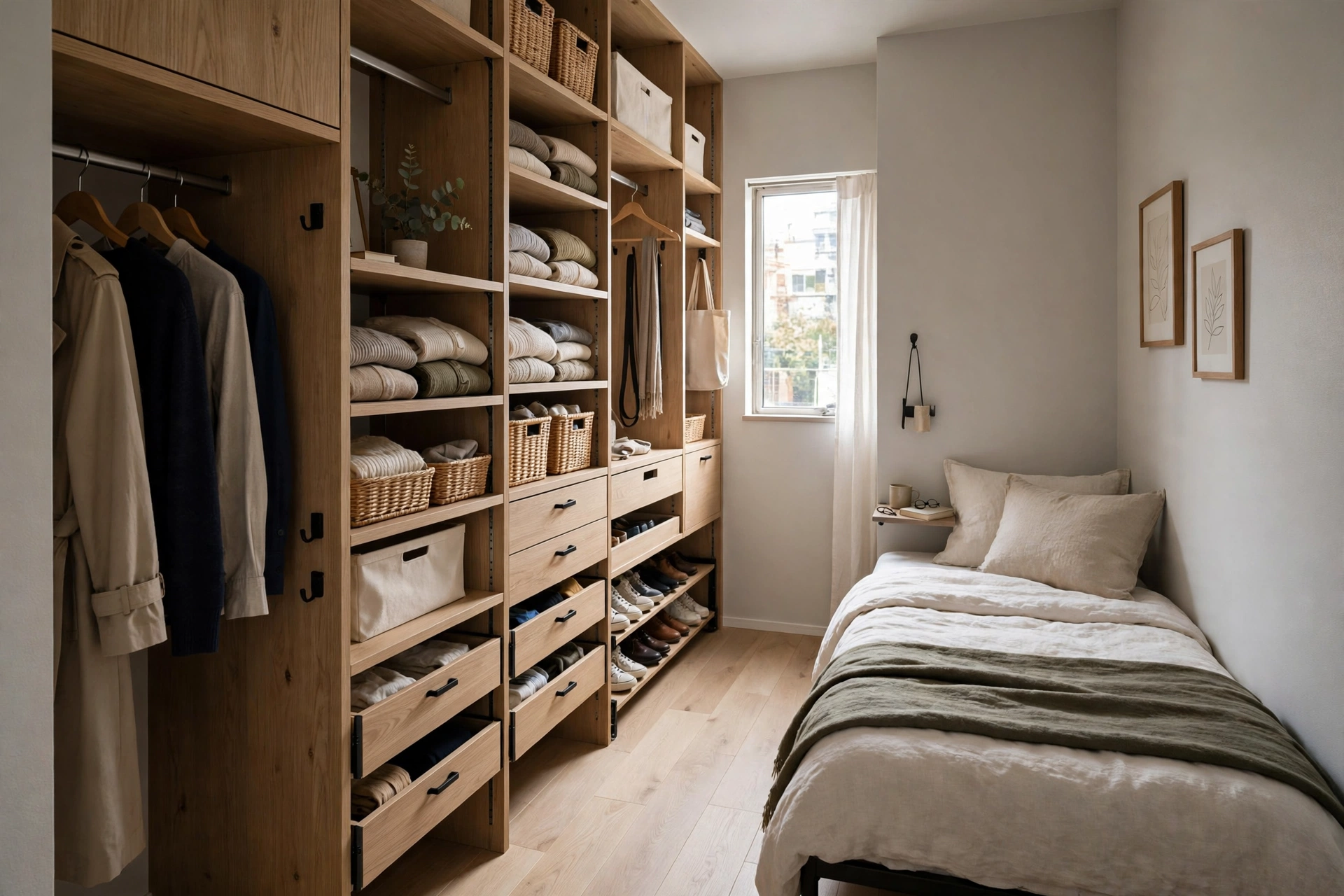
The single-wall reach-in layout, with all storage along one wall, is the most common answer for a narrow bedroom, because it preserves floor space and keeps the room layout simple. Double hanging, with two rods at different heights, effectively doubles hanging capacity for shirts, trousers, and short jackets, while a single long-hang section handles dresses and coats. Floor-to-ceiling vertical storage uses height that is otherwise wasted, with seasonal items on the highest shelf.
Corner and L-shaped layouts suit bedrooms where the closet turns a corner or wraps around an alcove, but they need careful planning so the corner does not become a dead zone. A compact walk-in can work in a small bedroom only if it is really a deep alcove with a clear path, not a full room carved out of an already narrow space. In most narrow bedrooms, a well-planned reach-in beats a cramped walk-in, because the walk-in consumes the floor space the bedroom cannot spare.
Closet System Types Compared for Small Apartments
For most small apartments, a modular system strikes the best balance between adaptability, cost, and performance. It can be reconfigured as needs change, it uses standard components that are easy to replace, and it does not require the commitment of a full custom build. Wire systems are a good temporary answer, especially in rentals, but their open design can make folded clothes look untidy and can leave marks on delicate fabrics if hangers are not chosen carefully.
Zoning a Narrow Closet by How Often You Wear It
Zone the closet by frequency, not by garment type alone. Daily clothes belong at eye level and within arm's reach: double-hung shirts and trousers, a drawer for underwear and accessories, and hooks for tomorrow's outfit. Weekly items such as work clothes and occasion wear belong slightly higher or further back. Seasonal and rarely worn items belong on the top shelf, in labelled boxes, where reaching them a few times a year is acceptable.
- Use slim, non-slip hangers throughout, because bulky hangers waste inches that a narrow closet cannot spare.
- Put shoes on a low shelf or a slim rack, toe to heel, rather than on the floor where they block the door.
- Add a small basket or drawer for accessories, belts, and scarves, so small items do not migrate onto shelves.
Lighting transforms a narrow closet more than most people expect. A battery or wired LED strip on a motion sensor means you can actually see the back of the closet, which is where narrow closets fail most. A mirror on the door or on the wall opposite the closet also helps a small bedroom feel larger, provided it does not block the closet opening.
Doors, Drawers, and Details That Save Inches in a Narrow Room
Doors deserve as much thought as the interior. A hinged door needs swing space that a narrow bedroom may not have, while a sliding door, a mirrored sliding door, or a pocket door frees that floor area for furniture. If the closet has no door, a curtain or an open design with finished shelving can work, provided the shelving is kept tidy and the bedroom colour palette is calm enough that an open closet does not dominate the room.
Drawers are worth their cost in a narrow closet, because they turn a deep shelf into accessible storage. A shallow drawer of 12 inches deep is more useful than a deep shelf where folded clothes are stacked three high and the bottom item is never reached. Pull-out accessories such as belt racks, tie racks, valet rods, and pull-out hampers use small gaps that would otherwise be wasted, and they keep the closet organised without adding bulk.
Installing a Modular Closet System in a Small Apartment
Most modular systems are wall-mounted on a rail or on vertical panels, which keeps the floor clear and makes cleaning easier. Mark stud positions before drilling, because a loaded closet system is heavy, and use appropriate fixings for plasterboard if studs are not where you need them. For rentals, prefer freestanding or tension-based systems, or ask the landlord before drilling, since a wall-mounted system leaves marks that may need repair on moving out.
Assemble the system in the room, not in the closet, and dry-fit the panels before fixing them. Check that rods clear the door, that drawers open fully without hitting the door frame, and that the top shelf leaves room for boxes to be lifted in and out. A system that looks perfect in the instructions but blocks the door by an inch is a system that will frustrate you every morning, so test the full range of movement before loading it with clothes.
Keeping a Narrow Closet Organised After the System Goes In
A closet system only stays useful if the habits around it stay simple. Put clothes away by zone, return hangers to the same rod, and do a short seasonal review: move out-of-season clothes to the top shelf or to under-bed storage, and remove anything unworn for a year. A narrow closet has no room for a backlog, so a one-in, one-out rule, where a new garment means an old one leaves, is more valuable here than in a large walk-in.
Small maintenance habits help too. Wipe shelves when seasons change, check that rods and brackets remain tight, and replace any bent wire shelving before it sags and damages clothes. If the closet starts to feel cramped again, the cause is usually volume, not layout: no system can store more than the closet holds, and editing the wardrobe is often the fastest space-saving upgrade available.
Rental-Friendly Closet Upgrades That Leave No Damage
Renters face the same narrow-closet problem without the freedom to drill into walls, so the best upgrades are the ones that add storage without fixings. A freestanding garment rail or a tension-rod shelf inside the closet, stackable fabric boxes on the top shelf, and over-door hooks for bags and accessories all add capacity without marks. A slim rolling cart beside the closet can hold shoes or folded clothes, and a freestanding wardrobe in the bedroom can take overflow if floor space allows.
Even without drilling, the same zoning rules apply: daily clothes at eye level, seasonal clothes up high, and shoes low and visible. Photograph the closet before moving in, keep any original shelving that you remove, and check the tenancy agreement before using adhesive hooks, which can damage paint on removal. A rental closet system should be judged by two tests at once: does it make mornings easier, and can it all be removed on moving day without a repair bill?
Final Thoughts: Fitting a Closet System to a Narrow Bedroom, Not the Other Way Round
The best space-saving closet system for a narrow bedroom is the one that fits your measured width and depth, doubles hanging where it helps, keeps daily clothes at eye level, and frees floor space with the right door. Measure first, choose a modular system that can adapt as needs change, zone by frequency, and the narrowest bedroom can feel organised, calm, and larger than its floor plan suggests.
Narrow Bedroom Closet System FAQs
What closet system is best for a narrow bedroom?
A modular, wall-mounted system with double hanging, adjustable shelves, and shallow drawers usually works best, because it adapts to the exact width and depth and uses vertical space. Custom built-ins fit awkward alcoves best, while basic wire systems suit tight budgets and rentals.
How deep does a closet need to be for hanging clothes?
Hanging clothes need roughly 24 inches of depth to hang without crushing against the door. Shelves for folded clothes work well at 12 to 16 inches deep, so a shallower closet is better planned around shelves, drawers, and hooks than around a full hanging rod.
Should I choose sliding doors for a narrow bedroom closet?
Yes, in most narrow bedrooms, because sliding or mirrored sliding doors do not need swing space and free floor area for furniture. Hinged doors can work if there is clear floor space, but they often block a bed or a dresser in a narrow room.
Are custom closets worth it in a small apartment?
Custom closets fit awkward spaces best and look most finished, but they cost most and cannot move with you. In a rental or a first apartment, a modular system usually gives most of the benefit at a lower cost and can be reconfigured later.
How can I make a small closet hold more without looking cluttered?
Use slim hangers, double hanging for short garments, shallow drawers for folded items, and labelled boxes on the top shelf for seasonal clothes. Zone by frequency so daily clothes are reachable, and edit the wardrobe regularly, since no system can store more than the closet holds.
What lighting works best inside a narrow closet?
A motion-sensor LED strip gives even light without taking storage space, and it lets you see the back of a deep closet. Avoid a single bulb that casts shadows, and pair the light with a mirror on the door or opposite wall to make the bedroom feel larger.