How to Improve Drainage Around a House With a Sloped Backyard and Soil Problems
Water is patient, and a sloped backyard with problem soil gives it plenty of opportunity. Rain runs down the slope, gathers speed, and arrives at the house carrying silt, then it meets soil that either drains too slowly, in the case of clay, or too unevenly, in the case of compacted or disturbed ground. The result is familiar: puddles against the foundation, a damp basement wall, a soggy strip of lawn that never dries, and erosion channels that deepen with every storm.
The short answer is to work in order: first send roof water well away from the house, then reshape the ground so it falls away from the foundation, then intercept the remaining surface and subsurface water with a swale or a French drain that has a real outlet. No single product fixes a drainage problem on its own, and a drain with nowhere to discharge will simply fill up. The sections below explain how to diagnose the slope and the soil, and how to choose the fix that matches both.
Reading a Sloped Backyard: Where Water Actually Travels
Start by watching the yard in heavy rain, or just after it, rather than guessing from a dry garden. Note where water sheets across the lawn, where it pools, how long pools last, and whether water runs towards the house or away from it at each wall. Mark low spots with stakes, and check gutters and downspouts at the same time, because roof water often explains a wet patch that looks like a ground problem.
Also note what the slope does at the boundaries. A backyard that slopes towards the house is a different problem from one that slopes away but has a flat or hollow band beside the foundation. A slope that ends at a fence, a patio, or a neighbour's higher ground can dam water against the house even when the overall fall looks correct. Drainage design starts with that observed path, not with a catalogue of products.
Soil Problems That Turn a Slope Into Standing Water
Soil type decides whether water on a slope soaks in, runs off, or sits. Clay holds water and swells, so it drains slowly and can press against foundations when saturated. Compacted soil, often found where builders drove machinery or where topsoil was stripped and replaced thinly, sheds water like pavement and creates runoff even on a gentle slope. Sandy soil drains quickly but erodes easily, carving channels that concentrate flow.
A simple test helps: dig a small hole, fill it with water, and watch how fast it drains. A hole that is still full hours later suggests tight clay or compaction, while one that empties in minutes suggests free-draining soil that may need erosion control more than drainage. Do not rely on a single hole, because soil varies across a yard, especially near foundations where backfill differs from the original ground.
Grading, Swales, and French Drains Compared for Sloped Yards
Most sloped yards need a combination, not a single solution. Regrading fixes the first few feet beside the house, a swale intercepts water further out, and a French drain deals with water that is already underground. Choosing only a French drain when the real problem is a negative grade beside the wall is a common and expensive mistake, because the pipe will collect water that grading should have sent away in the first place.
Fixing the Grade Beside the House on a Sloped Lot
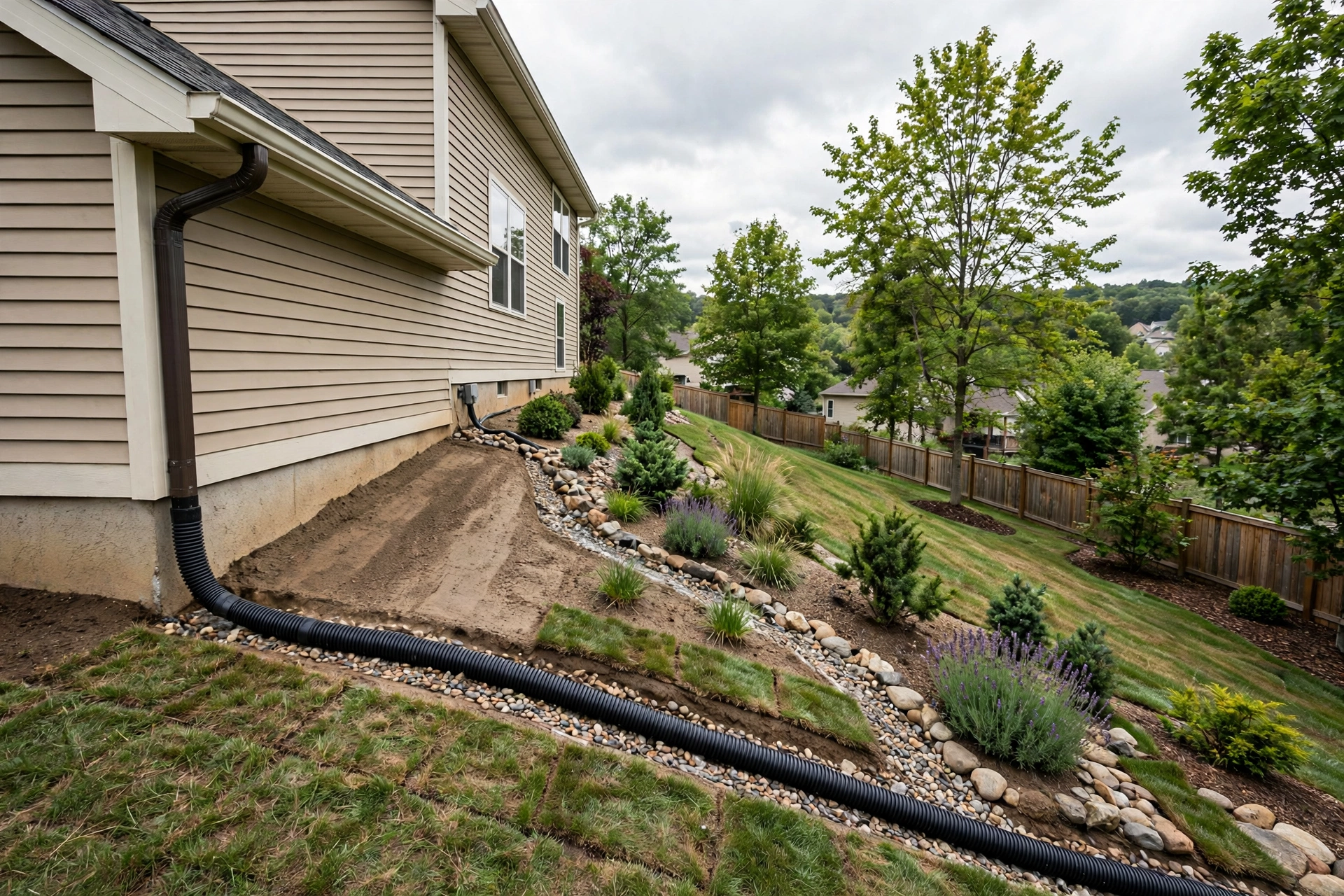
The ground beside a house should fall away from the wall, commonly by about six inches over the first ten feet, with the soil surface kept several inches below siding and timber. On a sloped lot, that fall must be created on the uphill side as well as the downhill side, which sometimes means cutting into the slope and building a small retaining edge, or using a swale to divert uphill water before it reaches the wall.
Use a dense, screened fill soil that compacts well, such as a silty clay loam, rather than pure topsoil, which settles unevenly and drains too quickly through the new grade. Place fill in thin layers and compact each layer lightly, rather than dumping a deep load at once, which will settle into a new hollow. Finish with turf or a ground cover that protects the new slope from erosion, and avoid landscape edging that acts as a dam and holds water against the wall.
Roof Water: The Drainage Problem Hiding in Plain Sight
A roof collects an enormous volume of water in a storm, and if downspouts discharge beside the foundation, that water will overwhelm even good grading. Extend every downspout at least six to ten feet away from the house, discharging onto ground that itself slopes away, or connect downspouts to solid underground pipe that leads to a safe outlet. Keep gutters clean and correctly sloped, because an overflowing gutter dumps a concentrated stream exactly where it does the most harm.
Do not connect roof water into a French drain designed for ground water without checking capacity, because a heavy storm can flood the drain and push water back towards the foundation. Roof water and ground water are best handled as separate systems that happen to share a downhill outlet, not as a single pipe that must cope with both at once.
Building a French Drain That Actually Discharges
A French drain is a trench containing a perforated pipe, wrapped in filter fabric and bedded in washed gravel, sloped continuously towards its outlet. The slope need not be steep, but it must be continuous, with no bellies where water sits and silt settles. Line the trench with fabric to keep fine soil out of the gravel, place the pipe with its holes facing down in most installations, and cover it with gravel before backfilling.
- Choose the outlet first: daylight at a lower point, a dry well, or a sump, and confirm it is legal and will not flood a neighbour.
- Keep the drain clear of roof downspouts unless the system is sized for roof volume as well as ground water.
- Mark the drain route and keep deep-rooted plants and heavy vehicles off it, which can crush the pipe.
A French drain in tight clay needs particular care, because water may never reach the pipe if the surrounding soil does not drain into the gravel. In that case, a wider gravel trench, a swale above it, or a different solution may be needed. If you are unsure, a drainage professional can test the soil and confirm whether a subsurface drain will actually intercept the water you are trying to move.
Erosion Control on a Slope While Drainage Work Settles
Drainage work disturbs soil, and disturbed soil on a slope erodes quickly. Protect new grades and trenches with turf, ground cover, mulch held by edging that does not dam water, or erosion-control matting on steeper sections. Avoid leaving bare soil through a rainy season, and check new work after the first heavy storm, when small rills will show whether water is following the intended path or cutting a new one.
Longer-term planting helps too. Deep-rooted grasses and shrubs slow surface flow and bind soil, while a rain garden in a low, well-drained spot can absorb runoff that would otherwise cross the yard. A rain garden is not a solution for water against a foundation, and it must be sited well away from the house, but as part of a wider slope strategy it can reduce the volume that reaches the lower yard.
When Sloped-Yard Drainage Needs a Professional
Some drainage problems are beyond a weekend scope. A slope that threatens a retaining wall, a basement that floods regularly, a spring that appears in the yard, or a lot with no downhill outlet all need professional assessment. Structural drainage, sump systems, and work near property boundaries or public storm drains may also need permits or neighbour agreement, and getting those wrong can create legal as well as practical problems.
Call a professional if water is entering the house, if the foundation shows new cracks or movement, or if you are planning a drain that crosses a neighbour's land or connects to a public system. A site visit and a soil test cost far less than a drain that fails, and a professional can confirm the outlet, the soil behaviour, and whether grading alone would have solved the problem.
Final Thoughts: Giving Sloped-Yard Water a Path Away From Your House
Improving drainage on a sloped lot with problem soil is a sequence, not a purchase: send roof water away, reshape the grade beside the house, intercept what remains with a swale or a French drain that has a real outlet, and protect the new work from erosion. Done in that order, the yard stops delivering water to the foundation, and the slope becomes an asset that carries water away instead of a problem that delivers it to the door.
Sloped Backyard Drainage FAQs
How much should ground slope away from a house?
A common standard is about six inches of fall over the first ten feet away from the foundation, with the soil surface kept several inches below siding. On a sloped lot, that fall must be achieved on the uphill side too, sometimes with a swale or a small retaining edge.
Why does water pool even though my backyard slopes?
A slope alone does not guarantee drainage. Compacted or clay soil, a flat band beside the foundation, a patio or fence that dams flow, or downspouts discharging at the wall can all create pooling on a yard that looks sloped overall.
What is the difference between a swale and a French drain?
A swale is a shallow, grassed channel that intercepts surface runoff and guides it downhill. A French drain is a buried perforated pipe in gravel that collects subsurface water. Many sloped yards need both, for surface and underground water respectively.
Where should a French drain discharge?
To a safe downhill point such as daylight at the back of the lot, a dry well, or a sump, where it will not flood a neighbour or return to the foundation. A French drain with no real outlet will simply fill up and stop working.
Can I fix drainage by adding topsoil beside the house?
Topsoil alone is rarely enough, because it settles unevenly and drains quickly. Use a dense, screened fill soil placed in thin, compacted layers to build a stable grade, then finish with turf or ground cover to prevent erosion.
When should I call a drainage professional?
Call one if water enters the house, the foundation shows new cracks, a spring appears, there is no downhill outlet, or the work involves a retaining wall, a sump, or a public storm drain. Those cases need site assessment and sometimes permits.