Innovative Residential Patio Subsurface Drainage Systems for Preventing Water Movement Toward Building Foundations
A patio should shed rain away from the house, but in many homes it quietly does the opposite, sending water under the slab and toward the foundation. The short answer is that subsurface drainage intercepts that water below the surface, before it can saturate the soil against the foundation wall: a French drain along the patio edge, a channel drain where the patio meets the house, and a proper discharge point working together. This guide explains how patio water reaches a foundation, how to read your soil and slope, and how to build a subsurface system that keeps the ground beside your house dry through the heaviest rain.
The damage rarely announces itself. A damp patch appears on a basement wall, a hairline crack widens near the patio door, or pavers start to tilt toward the house instead of away from it. By the time any of that is visible, water has been moving underground for months or years, and even small amounts of patio runoff can migrate a long way through clay-heavy soil. Subsurface drainage is prevention, and it costs far less than foundation repair, which is exactly why it belongs in the plan before the patio is laid, not after the first flood.
Why Patio Runoff Is a Foundation Problem, Not Just a Puddle
Water against a foundation wall creates hydrostatic pressure, the steady push of saturated soil and standing water against concrete and masonry. That pressure forces moisture through tiny cracks and porous blockwork, and in cold climates the freeze-thaw cycle turns trapped water into a slow jackhammer that widens every small defect. A patio makes the problem worse because its hard surface collects rainfall that would otherwise spread across a lawn, then concentrates it along one edge, often the edge nearest the house.
The second problem is what happens under the patio itself. Water that soaks beneath a slab or paver bed softens the sub-base, and pavers settle unevenly while concrete slabs crack and tilt. Once the surface tilts toward the house, every storm sends more water to the same spot, and the cycle accelerates. A subsurface system breaks that cycle at the source by giving water a faster, easier path away from the building than the slow route through the soil.
How Patio Water Reaches Your Foundation in the First Place
Rain falling on a patio has only a few places to go. Some runs off the surface toward the lowest edge, some seeps through joints between pavers, and some finds the narrow gap where the patio meets the house wall. Below the surface, water moves sideways through the gravel base and the soil beneath it, following the path of least resistance. In clay soils that path is slow but relentless, and water can travel many feet underground from a patio edge to a foundation wall, arriving long after the rain has stopped.
Roof water makes the load heavier. A downspout that discharges onto the patio, or a patio cover gutter that drains to the same corner, can deliver a large volume of concentrated flow exactly where the foundation is most vulnerable. That is why a drainage plan must account for roof runoff as well as rainfall on the patio itself. The system has to handle the worst storm, not the average one, because foundations are damaged by the few big events, not by ordinary drizzle.
Reading Your Yard: Soil, Slope, and Where Water Actually Goes
Before digging anything, spend a rainy afternoon watching the yard. Note where water pools, which direction it flows across the patio, and where the ground stays soggy longest after rain. A simple level and string line will show whether the patio actually slopes away from the house; the standard is about a quarter inch of fall per foot, or roughly a two percent grade. Many older patios fail this test, sloping toward the house or sitting dead level, and no drain can fully compensate for a surface that delivers water to the wrong place.
| Soil type | Drainage behaviour | What it means for the patio |
|---|---|---|
| Sandy or gravelly soil | Water passes through quickly | Subsurface drains work fast; outlets rarely back up |
| Loam | Moderate drainage | Standard French drain design usually performs well |
| Heavy clay | Water moves slowly and pools | Larger gravel beds and fabric-wrapped pipe are essential |
| Compacted fill | Almost no drainage at all | Assume water will travel sideways toward the foundation |
Soil type decides how generous the system must be. Sandy ground forgives small mistakes, but clay holds water against the foundation for days and needs a properly wrapped drain with clean gravel to keep working. If you are unsure what soil you have, dig a test hole, fill it with water, and time how fast it drains. That one cheap test tells you more about your drainage needs than any catalogue ever will.
French Drains Along the Patio Edge
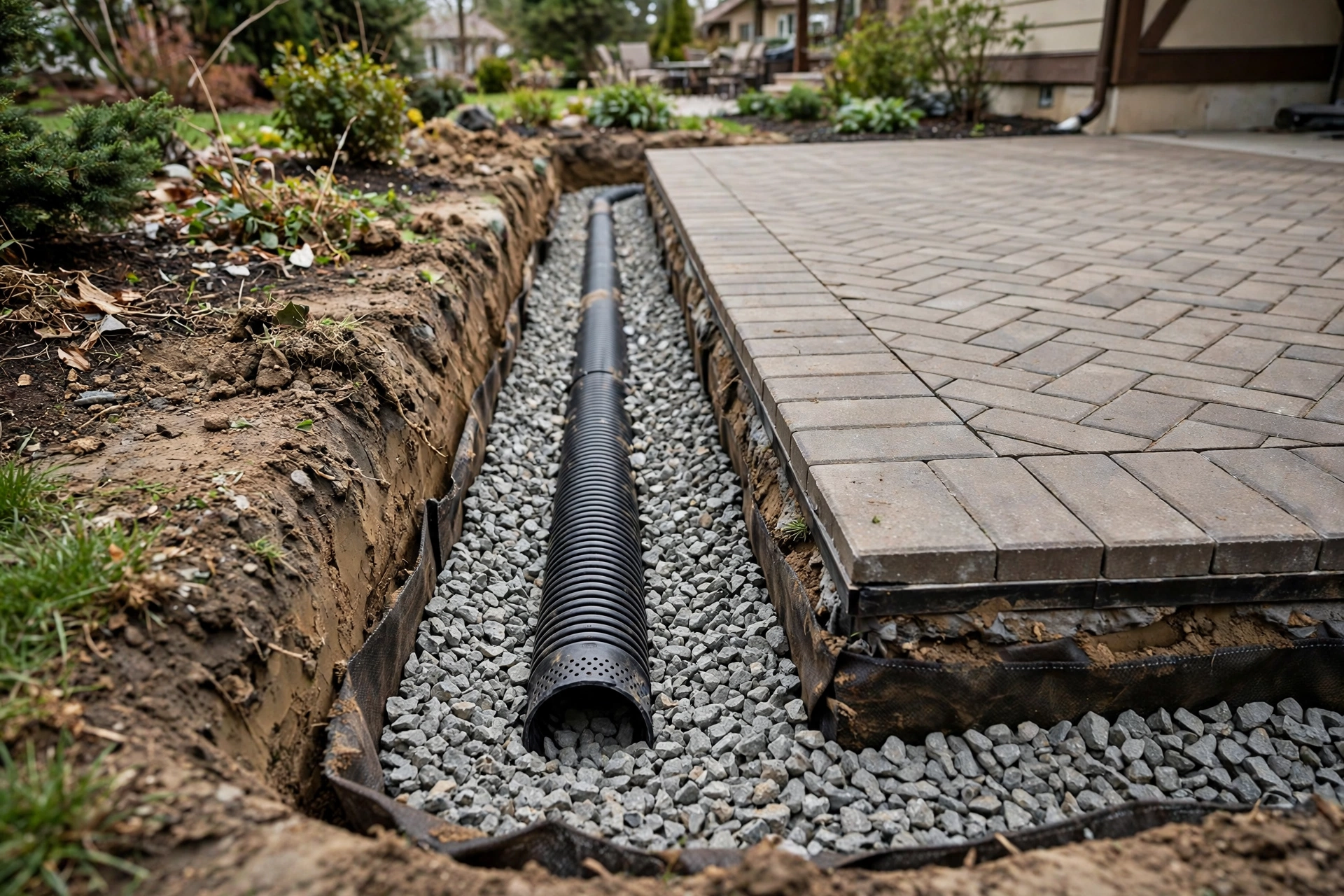
A French drain is the workhorse of patio subsurface drainage: a sloped trench holding a perforated pipe buried in clean gravel and wrapped in geotextile fabric. Laid parallel to the house, a foot or so from the foundation and twelve to eighteen inches deep, it intercepts water moving through the soil before it reaches the wall, then carries it to a safe outlet. Pre-wrapped bundle systems, where pipe and aggregate come as one unit, make the job simpler for a first-time installer and reduce the risk of a poorly wrapped trench.
- Mark the line first: stake the trench parallel to the house, about 12 inches from the foundation.
- Keep the fall steady: aim for at least an eighth of an inch of drop per foot toward the outlet.
- Wrap everything: geotextile fabric around the gravel and pipe keeps silt out and the drain open.
- Call before you dig: buried gas, sewer, and electric lines often run close to foundations.
- Add cleanouts: a vertical access pipe every 50 to 75 feet lets you flush the system later.
The fabric is the detail that decides whether the drain lasts five years or fifty. Without it, fine soil washes into the gravel and the pipe, and the system slowly chokes. With it, the drain keeps collecting water season after season. Take the time to wrap the trench properly and overlap the fabric generously at the top before backfilling.
Channel Drains Where the Patio Meets the House
When a patio cannot be re-sloped away from the house, because of door thresholds or existing levels, a channel drain is the standard answer. These modular troughs sit flush with the slab surface, topped with a removable grate, and run parallel to the exterior wall, catching sheet flow before it can press against siding, stucco, or the foundation. They are the right choice where the patio meets the house at the same level, and they handle far more water than a single round drain ever could.
Installation is straightforward but unforgiving about levels. The channel must sit exactly flush with the finished surface, with a steady fall toward its outlet, and the outlet pipe must be solid, smooth-walled pipe, not perforated, so the collected water is carried away rather than released back into the ground beside the house. Grates should be removable for cleaning, because leaves and grit will find their way in, and a blocked channel is worse than no channel at all.
Dry Wells, Pop-Up Emitters, and Where the Water Should End Up
Every drain needs a destination, and the destination decides whether the system actually protects the house. The best option is daylight: a pipe that emerges on a lower part of the yard and releases water well away from the building. Where the yard is flat, a dry well, an underground pit filled with gravel or a purpose-made chamber, gives collected water somewhere to soak away slowly. A pop-up emitter, a spring-loaded grate at the end of a solid pipe, is a tidy alternative that opens only when water pressure builds, then closes flat so it can be mown over.
- Daylight first: gravity discharge to a lower yard area is the simplest and most reliable outlet.
- Dry wells need good soil: they fail in heavy clay unless they are generously sized.
- Keep outlets clear: an emitter buried under mulch or a dry well full of silt protects nothing.
- Respect the rules: some areas restrict tying drains into storm sewers or sanitary lines.
- Plan an overflow: every system needs a safe route for water when a storm beats its capacity.
Whatever outlet you choose, keep it at least ten feet from the house where possible, and make sure the ground around it falls away from the building. An outlet that releases water beside the foundation simply moves the problem a few feet sideways, and a dry well placed too close to the house can saturate the very soil you are trying to protect.
Permeable Paving and Gravel Beds That Let Water Through Safely
Not all patio water needs to be piped away. Permeable pavers, laid on a deep bed of clean, open-graded gravel, let rainfall pass through the surface and into a storage layer below, where it soaks away slowly instead of running across the surface. That reduces the load on every other part of the system and keeps the patio usable in heavy rain. The key is the base: a shallow sand bed will not do, and the gravel layer must be deep enough and clean enough to store a storm’s worth of water.
Gravel beds work the same way along patio edges, acting as a shallow infiltration strip that catches runoff before it reaches the foundation. They are simple, cheap, and effective on free-draining soils, but they are not a substitute for a piped drain in clay ground, where infiltration is too slow to matter. Treat permeable paving as a partner to the French drain and the channel drain, not as a replacement for them.
Patio Drainage Mistakes That Push Water Toward the House Instead
The most common mistake is a drain that discharges beside the foundation, often because the pipe run was cut short to save digging. The second is a French drain laid flat, with no fall toward its outlet, so water sits in the pipe and the trench becomes a long, damp soakaway against the house. The third is skipping the geotextile fabric, which guarantees a clogged drain within a few seasons. And the fourth is forgetting the roof: a downspout pouring onto the patio can overwhelm a system that was sized for rainfall alone.
Each of these mistakes shares one root cause: treating drainage as an afterthought instead of a designed system. A patio drainage plan drawn before the first shovel hits the ground, showing slopes, pipe runs, outlets, and roof water, costs nothing and prevents every one of them. If the patio already exists and the problems are already visible, the same plan, drawn now, is still the cheapest way to fix it properly.
Patio Subsurface Drainage FAQs: Slopes, Pipes, and Upkeep
How deep should a French drain beside a patio be?
Twelve to eighteen inches deep is typical for a patio-edge French drain, with the pipe bedded on at least two inches of washed gravel and covered by six inches or more of the same material. The trench must fall steadily toward its outlet, at least an eighth of an inch per foot, so water keeps moving instead of sitting in the pipe.
Can I connect a patio drain to the storm sewer?
It depends on local rules, and in many areas a direct connection needs permission or is not allowed at all. Check with your local authority before tying any drain into a public system. In most cases, discharging to daylight on your own land, or to a properly sized dry well, is the simpler and safer route.
Do permeable pavers replace a French drain?
No, not on their own. Permeable pavers reduce surface runoff and help on free-draining soils, but in clay ground they cannot move water away fast enough to protect a foundation. Use them alongside a French drain and a channel drain, so each part of the system does the job it is best at.
How often should a patio drainage system be cleaned?
Inspect channel grates and outlets at least twice a year, in spring and autumn, and flush the French drain through its cleanouts once a year. Leaves, grit, and silt are the usual culprits, and a ten-minute flush is far cheaper than digging up a drain that has quietly clogged.
What slope does a patio need to drain away from the house?
About a quarter inch of fall per foot of run, which is roughly a two percent grade, is the standard for a patio surface. Anything less lets water linger, and a patio that slopes toward the house needs either re-grading or a channel drain along the wall to intercept the flow before it reaches the foundation.
Final Thoughts: Dry Patio Edges Mean a Dry Foundation
A patio drainage system is invisible when it works, and that is exactly the point. A French drain along the edge, a channel drain where the patio meets the wall, and an outlet that carries water well away from the house together remove the slow, hidden pressure that damages foundations. Build it before the patio is laid if you can, and build it properly if the patio already exists. The ground beside your house will stay dry, the slab will stay level, and the foundation will never have to prove how much water it can take.