Best Driveway Drainage Designs for Preventing Standing Water and Surface Deterioration
Standing water is the quiet enemy of every driveway. A puddle that lingers after rain does more than look untidy: it seeps into the surface, weakens the base underneath, and, in cold weather, freezes and expands, lifting and cracking the slab a little more with each cycle. Over time, what starts as a damp patch becomes scaling, settlement, and potholes, and the repair bill grows from a small drainage fix into a full replacement. Good drainage design prevents that chain of damage before it starts.
The direct answer is that the best driveway drainage design combines a gentle slope of 1 to 2 percent away from the house, a compacted free-draining sub-base, and a collection system matched to the site: channel drains at the low edge, a French drain or swale along the perimeter, and a soakaway or rain garden where the water can safely disperse. Permeable surfaces add another layer of protection by letting rain soak through instead of running off. This guide explains how to read your driveway’s water problem, compare the main drainage options, and install and maintain a system that keeps the surface dry.
How to Read Your Driveway’s Slope and Low Spots
Before choosing any drain, find out where the water actually goes. On the next heavy rain, watch the driveway from a window and note where puddles form, which direction the water runs, and whether any of it flows toward the house or the garage. Mark the low spots with chalk once the rain stops, and check whether the ground beside the driveway is higher than the slab, which would send water back onto the surface instead of away from it.
A simple level check confirms what your eyes suggest. Lay a long straight board on the driveway with a spirit level on top, and measure the fall over its length; a well-built driveway drops roughly 1 to 2 percent, or about 3 to 6 millimetres per 300 millimetres of run, away from the building. If the surface is flat or slopes back toward the house, no drain at the edge will fully solve the problem, and regrading or resurfacing may be needed first. Also check the soil: clay holds water and makes pooling worse, while sandy or gravelly ground drains freely and suits a soakaway.
How Channel Drains Move Water Away From the Low Edge
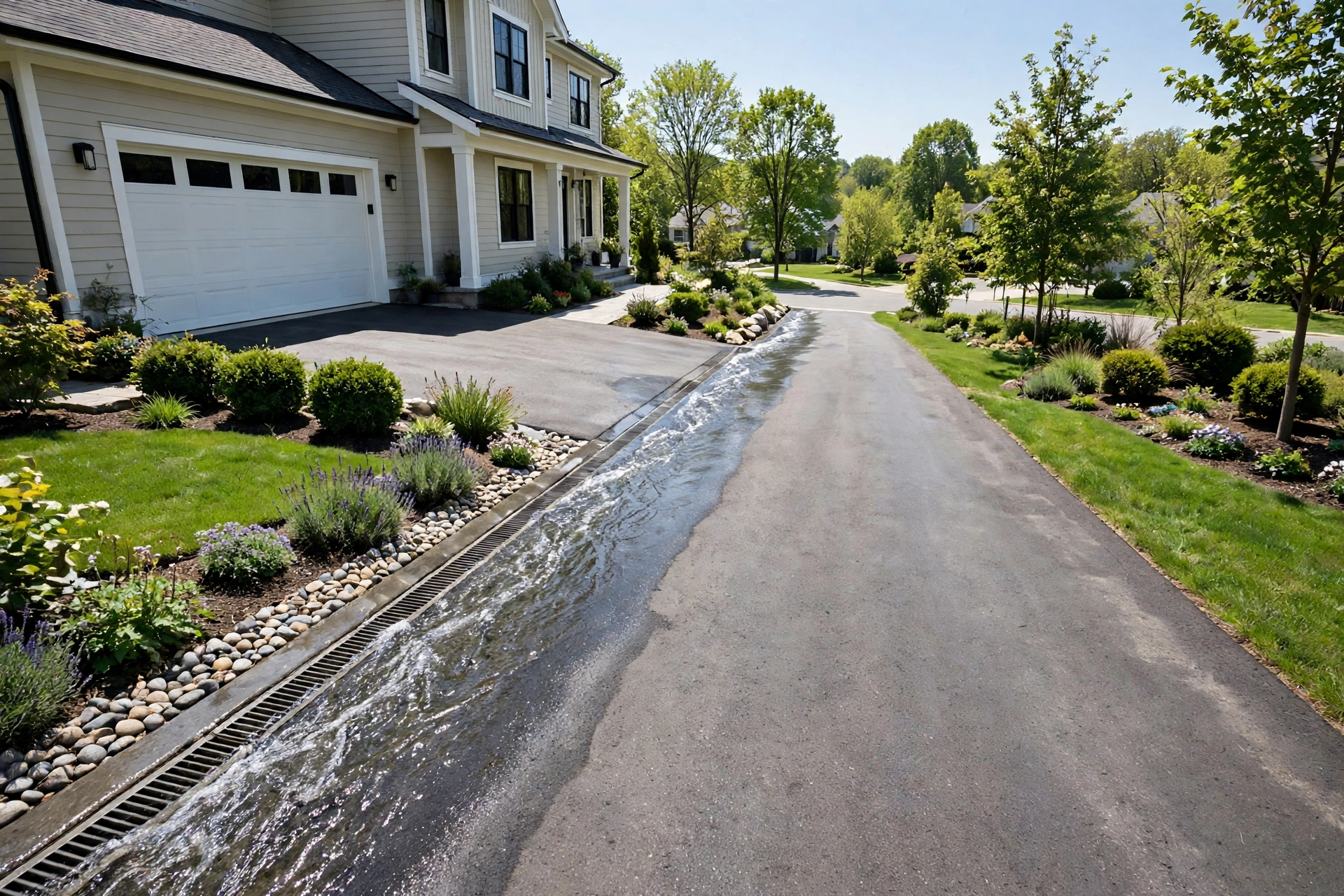
A channel drain is a long, narrow grated trough set flush with the driveway surface, usually along the low edge, across the garage threshold, or at the base of a slope. Surface water flows into the grate and is carried away through a pipe to a soakaway, a rain garden, or the stormwater system. Because the grate sits level with the surface, cars can drive over it safely, and it handles large volumes of water quickly during heavy rain.
Channel drains come in different load classes, so choose one rated for vehicle traffic rather than a light garden-duty model, and check that the grate can be lifted for cleaning. They work best when the driveway already has a clear fall toward them; a channel set in a flat area will collect only the water that happens to reach it. Keep leaves and grit out of the grate, since a blocked channel is worse than none at all: water backs up and spreads across the driveway instead of draining away.
French Drains and Perimeter Drainage That Protect the Edges
Much driveway damage starts at the edges, where water running off the slab has nowhere to go and instead soaks into the ground beside it, softening the sub-base from the side. A French drain solves this with a gravel-filled trench, usually 300 millimetres wide and 300 to 450 millimetres deep, holding a perforated pipe that collects water and carries it downhill. The trench is lined with geotextile fabric to keep soil out of the gravel, and the top can be finished with decorative stone so it looks like a deliberate border.
French drains suit driveways on clay or on sloping ground, where water arrives from the lawn as well as from the slab itself. They need a genuine outlet: a soakaway, a lower ditch, or a stormwater connection. A French drain that ends in a dead end simply fills up and stops working. Dig the trench with a consistent fall of at least 1 percent toward the outlet, and avoid routing it across tree roots or buried services without checking their location first.
Permeable Surfaces That Let Rain Soak Through
Permeable paving turns the driveway itself into part of the drainage system. Permeable block paving looks like standard paving, but the joints and the sub-base are designed so rainwater soaks through into a stone reservoir below and then disperses into the ground. Gravel driveways work on the same principle, with a permeable membrane beneath the gravel to stop weeds while letting water pass. In some areas, driveways over a certain size must be permeable or drain to a soakaway on the property, so check local rules before rebuilding.
Permeable surfaces need the right build-up to work: a compacted but open-graded stone base, usually 150 millimetres or more, with no fine material that would clog the voids. They are less suited to very heavy vehicles or to sites where the ground is already saturated clay, since water has nowhere to go. Maintenance is simple but regular: sweep the joints clear of silt and leaves, and top up gravel or jointing grit as it settles. A permeable driveway that is allowed to clog will behave like an ordinary one, and the puddles will return.
Soakaways and Rain Gardens: Where the Water Should End Up
Every drain needs a destination, and a soakaway is the most common one where the ground drains well. It is an underground chamber, traditionally a rubble-filled pit and now usually a plastic crate, that stores rainwater and lets it seep slowly into the surrounding soil. Size it to the roof and driveway area it serves, place it at least 5 metres from the house, and keep it clear of tree roots that could block or damage it.
Where the soil is too heavy for a soakaway, a rain garden is a better answer: a shallow planted hollow that collects runoff, holds it briefly, and lets it soak away through improved soil. Native plants that tolerate both wet and dry conditions suit it best, and the garden doubles as an attractive feature rather than a hidden structure. Whichever outlet you choose, never direct driveway water onto a neighbour’s land or into a foul sewer, and check local regulations before connecting anything to the public stormwater system.
Installing a Channel Drain in Seven Steps
Mark the drain line at the low edge of the driveway and check the fall with a level so water will flow toward the outlet.
Cut a trench wide and deep enough for the channel body plus a concrete bed, usually about 100 millimetres of concrete beneath it.
Lay a concrete bed in the trench and set the channel sections into it, checking each one is level and flush with the driveway surface.
Connect the channel outlet to a pipe leading to the soakaway, rain garden, or stormwater connection, keeping a steady fall along the pipe.
- Seal the joints between channel sections so water cannot leak into the base below.
- Backfill and finish the edges, then leave the concrete to cure before driving over the drain.
- Test the drain with a hose, watching that water flows into the grate and away to the outlet without pooling.
Keeping Driveway Drains Working Year After Year
Drainage fails slowly, through neglect rather than sudden breakage, so a short seasonal routine protects the whole system. Clear leaves from channel grates in autumn, flush French drains and gullies in spring, and check after heavy storms that water is still moving to the outlet. Reseal the driveway surface every few years to slow water penetration, and repair small cracks promptly, since water entering a crack in winter will widen it with each freeze.
- Sweep permeable joints clear of silt and leaves so water can keep soaking through.
- Lift channel grates twice a year and remove grit, leaves, and sediment from the trough.
- Check the soakaway area for soggy ground, which can signal that it is full or blocked.
- Keep heavy vehicles off the edges of the slab, where the base is thinnest and most easily damaged.
Driveway Drainage Problems That Need a Contractor
Some drainage problems are beyond a weekend fix. A driveway that slopes toward the house, a slab that has settled badly, or a site with a high water table needs professional survey and redesign, not just a new drain. Work that connects to the public stormwater system usually needs permission, and any excavation near gas, water, or electrical services must be checked against utility plans before digging begins.
Call a contractor when water is entering the house, when the driveway has sunk or cracked across its full width, or when a previous drain has failed and you cannot find why. A good contractor will survey levels with a laser, test the soil, explain the outlet options, and price the work as a complete system rather than a single drain. Be wary of anyone who offers to lay a new surface over a driveway that still ponds water: the new surface will fail in the same places as the old one.
Final Thoughts: A Dry Driveway Starts With the Design
A driveway that stays dry is not an accident; it is the result of slope, sub-base, and drainage designed together. Give the surface a clear fall away from the house, build the base from free-draining compacted stone, collect the water with a channel or French drain, and send it somewhere it can safely disperse. Maintain the system with a little seasonal cleaning, and the surface will last years longer, look better, and cost far less to own. Start by watching where the water goes after the next rain, and let that decide which drain your driveway needs.
Driveway Drainage FAQs
What slope should a driveway have for drainage?
A fall of 1 to 2 percent away from the house is the usual target, which is roughly 3 to 6 millimetres of drop per 300 millimetres of run. Less than that and water lingers; much more and the driveway feels steep and can be slippery.
Which drain is best for a driveway that ponds in the middle?
A central low spot usually means the slab has settled or was built flat. A channel drain across the low area can collect the water, but the lasting fix is often to regrade or resurface so the whole driveway falls toward the drain.
Do I need planning permission for driveway drainage?
Rules vary by area, but many places require new or replacement driveways above a certain size to be permeable or to drain to a soakaway on the property. Connecting to the public stormwater system usually needs permission, so check local rules first.
How often should I clean a channel drain?
Lift the grates and clear sediment at least twice a year, and always after autumn leaf fall. A blocked channel can cause worse flooding than having no drain, since water backs up across the driveway.
Can a French drain fix a driveway on clay soil?
It can help at the edges, but clay drains slowly, so the outlet matters more than the trench. On heavy clay, a French drain needs a genuine outlet such as a stormwater connection or a large soakaway, and permeable paving alone is rarely enough.
Is permeable paving worth the extra cost?
On a new or replacement driveway it often is, because it removes the need for separate drainage in many cases and keeps the surface free of puddles. On heavy clay or very steep sites the benefit is smaller, so weigh the ground conditions before deciding.