Best Foundation Waterproofing Solutions for Homes Built in High-Moisture Environments
The best foundation waterproofing for a home in a high-moisture environment is a layered system: exterior drainage and grading first, an exterior membrane where excavation is practical, an interior perimeter drain with a sump pump for water that still gets in, and crack injection for individual leaks. There is no single product that fixes every wet foundation, because water enters through the wall face, through cracks, through the floor-wall joint, and up through the floor, and each path needs its own answer.
Reading the Signs Your Foundation Is Taking on Water
A foundation rarely fails overnight. It sends signals for years, and the homeowners who act on the early ones spend far less than those who wait for a flood. Look for efflorescence, the white mineral powder left behind when water evaporates from concrete or block. Look for damp patches that darken after rain, musty odors that never fully leave the basement, rust on the furnace or washer, and paint or sealer peeling from the wall. Horizontal cracks, stair-step cracks in block walls, and bowing walls are more serious: they mean soil pressure is pushing the wall inward, and they need a structural assessment, not just a coat of paint.
Before spending money, find out where the water is coming from. Watch the wall during a heavy rain and note whether water appears at a crack, at the floor-wall joint, across a broad damp area, or up through the floor. Each pattern points to a different fix, and matching the method to the source is the difference between a dry basement and a second, more expensive round of work.
Where Does Foundation Water Come From in Wet Ground?
In high-moisture environments, water reaches a foundation from four directions at once. Surface water runs toward the house when grading is flat or slopes inward, and downspouts that discharge at the wall make the problem worse. Groundwater rises with the water table after rain or snowmelt and presses against the footing and the floor slab. Water also moves through the soil by capillary action, soaking into porous concrete block and mortar joints. And hydrostatic pressure builds up against the wall when the soil around it is saturated, pushing water through the smallest crack or joint. A waterproofing plan that ignores any of these sources leaves an open door.
- Surface water: fixed with grading, gutters, and downspout extensions that move water at least six feet from the house.
- Groundwater: managed with footing drains, interior perimeter drains, and a sump pump sized for the water volume.
- Capillary moisture through block walls: controlled with interior drainage channels and, where practical, an exterior membrane.
- Hydrostatic pressure: relieved by drainage, not by paint or sealer, because no coating holds back sustained pressure.
This is why waterproofing paint alone almost never solves a wet basement. Paint and masonry sealers can slow vapor through a porous wall, but they cannot hold back hydrostatic pressure, and they peel once water finds a path behind them. They are a finishing touch, not a system.
Exterior Waterproofing: Stopping Water Before It Touches the Wall
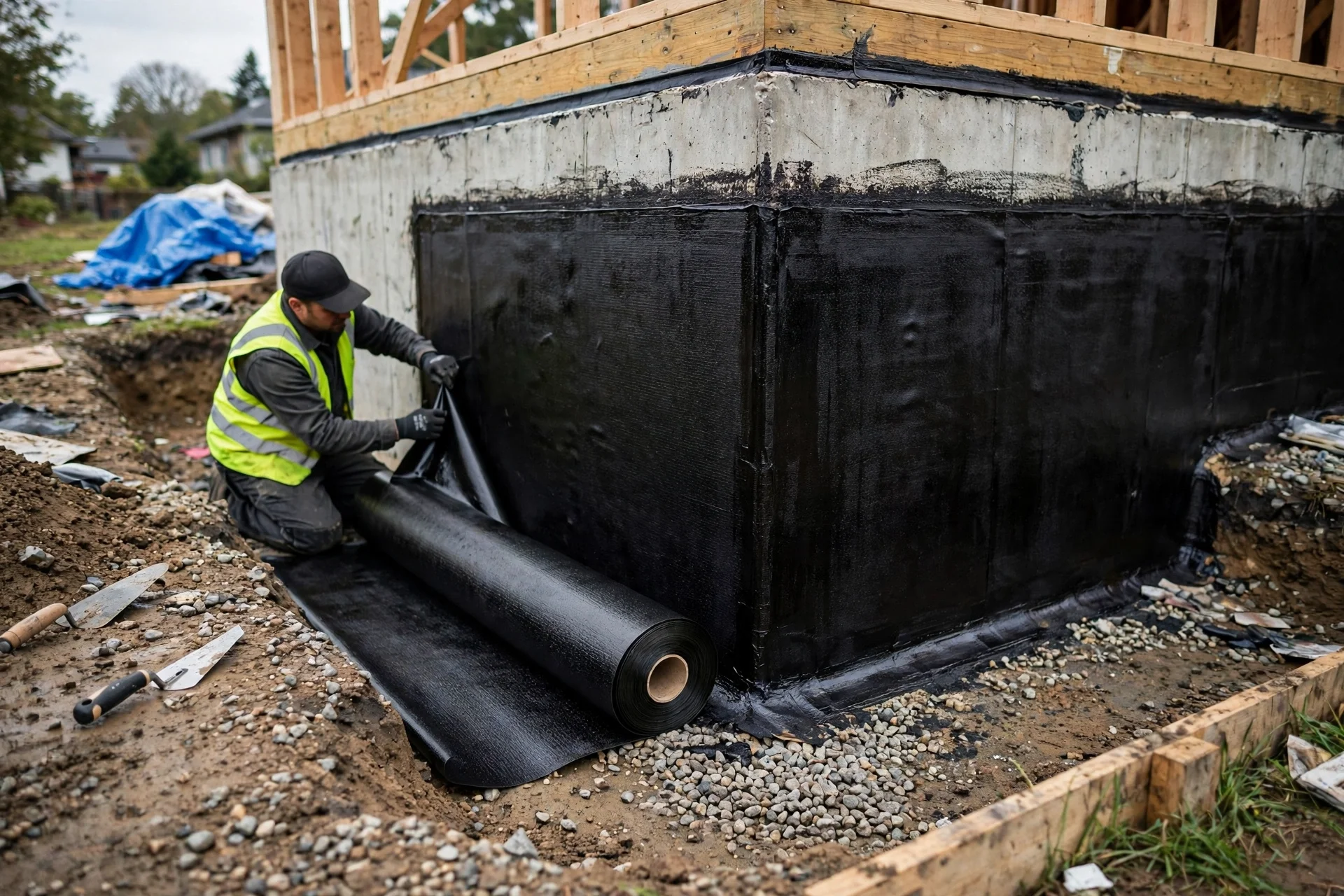
Exterior waterproofing is the most complete approach, because it stops water at the source. The foundation is excavated to the footing, the wall is cleaned and repaired, a rubberized membrane is applied to the outside face, a drainage board is installed to carry water downward, and the footing drain is replaced or added. The membrane creates a seamless, bonded barrier, and the drainage board protects it during backfill while channeling water to the drain tile. For chronic leaks in high-moisture soil, this is often the best permanent fix.
The drawback is cost and disruption. Excavation disturbs landscaping, driveways, and patios, and it requires heavy equipment and careful backfill to avoid damaging the new membrane. It is also impractical where a deck, addition, or neighbor’s property blocks access to the wall. In those cases, interior systems do the heavy lifting, and the exterior work is limited to grading and drainage improvements that can be done without digging.
The footing drain deserves as much attention as the membrane itself. A perforated pipe laid beside the footing, wrapped in filter fabric and buried in clean gravel, carries water away before pressure can build against the wall. Old clay tile drains collapse and clog over decades, which is why many older homes leak even though they were waterproofed when built. During excavation, replacing the footing drain and connecting it to daylight or to a sump pit is one of the highest-value parts of the job, and skipping it leaves the new membrane fighting pressure it was never meant to resist alone.
Interior Drainage: Catching Water and Sending It Out
Interior waterproofing does not stop water from touching the foundation wall, but it intercepts water before it can damage the living space and directs it safely away. The standard system is an interior perimeter drain, often called drain tile, installed in a trench cut into the floor slab along the basement walls, feeding a sump pit where a pump discharges the water outside. A dimple-mat drainage board against the wall can channel water seeping through block walls down into the same drain.
An interior system is less invasive, can be installed year-round, and is often the most practical solution when water enters through the floor or the floor-wall joint rather than through the wall face. Its weakness is dependence on the pump: if the pump fails or the power goes out during a storm, the system stops working. A battery backup and a water-powered backup pump are cheap insurance against exactly that scenario.
Sump Pumps, Crack Injection, and the Details That Decide Success
A sump pump is the last line of defense in any interior system, so size it for the water volume your home actually sees, not the smallest unit on the shelf. A primary pump with a battery backup covers most storms, and an alarm that sounds when the water rises gives you warning before the floor gets wet. Test the pump twice a year by pouring water into the pit, clean the intake screen, and confirm the discharge line runs well away from the foundation and does not freeze in winter.
- Inject individual cracks in poured concrete with polyurethane foam, which flexes with the wall and seals the full depth of the crack.
- Repair the exterior drainage first, because injection cannot hold back water that is being driven at the wall by poor grading.
- Add a battery backup and an alarm to the sump system before the rainy season, not after the first flood.
- Re-check the wall after the first heavy rain following any repair, and photograph the results for your records.
Crack injection deserves a special note: it works well on a single crack in a poured concrete wall, where the foam fills the full depth and stays flexible as the wall moves. It does not work on block walls, where water moves through many small paths, and it cannot fix a wall that is bowing or structurally unsound. Those conditions need a structural engineer and a different repair entirely.
Not every wet foundation is a waterproofing job. A wall that bows inward, leans, or shows horizontal cracking is a structural problem, and no membrane or drain will fix it. Lateral soil pressure, especially from expansive clay that swells when wet, can push a block wall inward by inches over time, and a wall in that condition can fail suddenly. If you see a bow you can measure with a straight edge, stair-step cracks that are widening, or a wall that has moved since the last time you looked, stop the waterproofing plan and call a structural engineer first. The engineer may recommend wall anchors, carbon fiber straps, or steel bracing, and those repairs should be completed before any waterproofing work begins.
The same rule applies to homes with a history of settlement. Cracks that reopen after repair, doors that stick more each year, and floors that slope toward one corner all suggest the foundation is still moving. Waterproofing a moving foundation is like painting a sinking boat: the work looks finished until the next season undoes it. A professional assessment costs far less than a waterproofing system installed on a foundation that still needs structural repair.
When a Bowing Wall Means Stop and Call an Engineer
What Waterproofing Costs in High-Moisture Areas
Costs vary widely with region, access, and the size of the foundation, so treat the figures below as broad estimates rather than quotes. Extending downspouts and regrading a yard may cost a few hundred dollars. A sump pump installation typically runs in the low thousands, and an interior perimeter drain with a sump pump often falls in the range of a few thousand to around eight thousand dollars. Exterior excavation with a new membrane is the most expensive option, commonly running well into five figures for a full perimeter. Get at least three quotes, compare the scope line by line, and be wary of any contractor who promises a permanent fix from a single coat of paint.
The cheapest fix is the one done once. A homeowner who spends a little on grading and gutters, then invests in the right drainage system, usually spends less over ten years than one who pays repeatedly for sealers, paints, and emergency pump-outs. Keep records of every repair, because a documented waterproofing history is also a selling point when the home changes hands.
Final Thoughts: Waterproofing Your Foundation for Wet Conditions
In a high-moisture environment, a dry foundation comes from a system: grade the yard and extend the downspouts, stop water at the wall with an exterior membrane where you can, manage what gets through with an interior drain and a reliable sump pump, and seal individual cracks properly. Match each method to the water source it actually controls, test the system before the rainy season, and the foundation will stay dry, stable, and sound for decades.
Foundation Waterproofing FAQs
What is the difference between damp proofing and waterproofing?
Damp proofing is a thin tar coating that slows moisture vapor; it was standard on older foundations and is not a true waterproofing system. Waterproofing uses a membrane plus drainage to block liquid water and relieve pressure, which is what high-moisture sites actually need.
Is interior or exterior waterproofing better?
Exterior waterproofing is more complete because it stops water before it reaches the wall, but it costs more and needs excavation. Interior drainage is less invasive and often the practical choice when water enters through the floor or floor-wall joint. Many wet homes end up with both.
Can foundation waterproofing be done in winter?
Interior work can be done year-round. Exterior excavation is harder in frozen ground and is usually scheduled for warmer months, though emergency interior drainage can be installed any time of year.
How long does an exterior waterproofing membrane last?
A properly installed rubberized membrane with drainage board can last several decades, often for the remaining life of the foundation. Its lifespan depends on the quality of the installation, the backfill, and the drainage system that protects it.
Will waterproofing paint stop a leaking basement?
No, not against hydrostatic pressure. Paint and masonry sealers slow vapor through porous walls, but water under pressure will find a path behind them and peel the coating off. They are a finishing step, not a fix for active leaks.
Do I need a permit for foundation waterproofing?
It depends on the scope and the local rules. Exterior excavation, structural repairs, and changes to drainage usually need a permit and an inspection, while interior sealers and crack injection often do not. Check with the local building department before starting work.