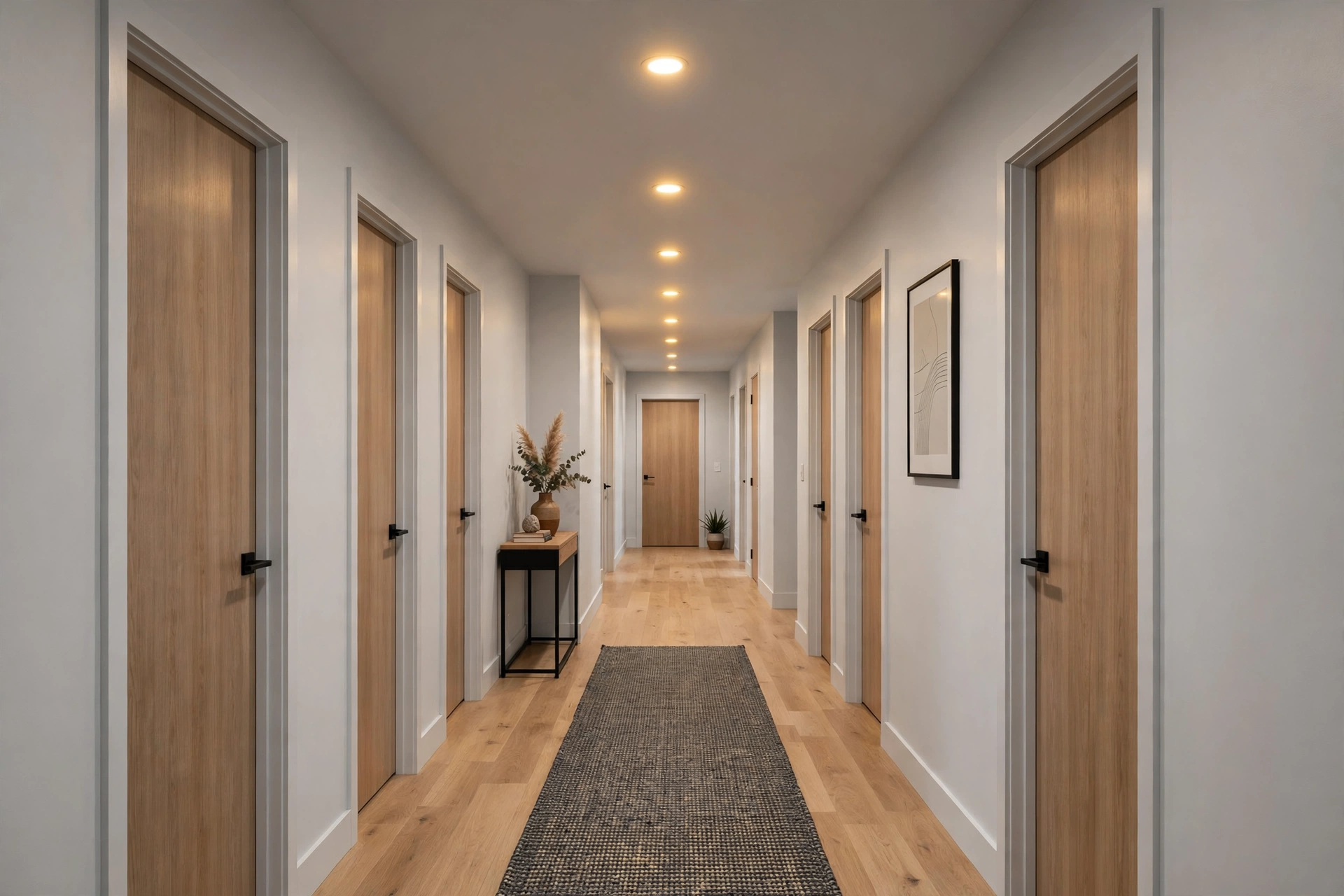
Energy-Efficient Lighting Designs for Long Hallways With Limited Access to Natural Daylight
A long hallway with no windows and no borrowed daylight is one of the hardest spaces in a home to light well. One bright fitting in the middle leaves both ends in gloom, a row of harsh downlights turns the corridor into a runway, and lights left burning all day quietly inflate the electricity bill. The fix is not a bigger bulb: it is a layered, low-wattage design that spreads light evenly along the whole passage and switches itself off when nobody is there.
- In short: Layer several small LED sources instead of one powerful one, space them evenly along the hallway, set them to warm white, and control them with a motion sensor and a dimmer. That gives even, shadow-free light exactly when the hallway is in use, typically using around 75 percent less energy than old incandescent fittings.
Why a Long, Windowless Hallway Swallows Light Differently Than a Room
In an ordinary room, daylight does much of the work during the day and electric light only tops it up in the evening. A hallway with limited access to natural daylight gets no such help, so its lighting carries the full load morning and night. Its shape makes it harder still: a long, narrow passage has a large wall and floor area relative to its volume, so much of the light is absorbed by surfaces before it reaches the eye, while a pale ceiling reflects light back down and stretches every lumen further.
How Many Lumens a Shadow-Prone Hallway Actually Needs
Shop by lumens, not watts. Watts measure power used; lumens measure light produced, and that is what your eyes care about. Lighting guides commonly put hallways at the low end of residential brightness — roughly 5 to 10 footcandles, or around 10 to 15 lumens per square foot — because a hallway is for safe movement, not reading. Multiply floor area by that figure for a rough total, then split it across fixtures. Treat the figures below as estimates.
Recessed Downlights Down the Centre: Spacing That Erases Dark Patches
Recessed LED downlights are the workhorse of long-hallway lighting: flush with the ceiling, out of the way in a narrow passage, and throwing an even pool of light downwards. The classic spacing rule is simple — place fixtures about half the ceiling height apart. Under a standard 8-foot ceiling, that means roughly 4 feet between centres, with the first and last fixtures about half that distance from the end walls.
Choose small, wide-beam downlights rather than a few powerful narrow ones: a 4-inch LED producing 600 to 800 lumens, with a beam angle of 60 degrees or more, overlaps generously with its neighbours. Keep every downlight on the same colour temperature, use IC-rated housings wherever insulation touches the fitting, and put the run on a dimmer from the start.
Wall Washers and Sconces That Stretch a Narrow Corridor Visually Wider
Downlights light the floor; walls are what make a hallway feel wide or cramped. Wall-washing fixtures throw light across a wall surface, and because a lit wall appears to recede, they are the most effective trick for a narrow corridor. Space sconces evenly on one or both walls, roughly every 6 to 8 feet, at about 60 to 66 inches from the floor to the centre of the fitting, and choose shallow designs projecting no more than about 4 to 5 inches.
Sconces also solve a problem downlights cannot: glare at eye level. A shaded sconce, or an uplight that bounces off the ceiling, hides the source and delivers light indirectly, which feels softer than its wattage suggests. Aim one or two wall washers at a picture, a mirror, or a console table — a lit focal point at the far end draws the eye forward and shortens the perceived distance.
LED Strips Along Skirting, Cove, and Handrail Lines for Glow Without Glare
LED strip lighting is the most energy-frugal way to add a second layer of light to a long hallway. A strip draws only a few watts per metre, produces no visible bulb, and can run along a ceiling cove, under a handrail, or behind a skirting board to create a continuous line of glow. Because the source is hidden there is no glare, and because the line runs the full length of the hallway there are no dark patches at all.
Placement changes the effect. A strip in a ceiling cove washes the ceiling with light and makes a low ceiling feel higher, while a strip along the skirting line throws a soft wash across the floor — ideal as a night light, bright enough to walk safely, dim enough not to wake the household. Mount strips in an aluminium channel with a diffuser, which turns individual dots into one smooth line, and size the power supply about 20 percent above the strip’s total wattage so it runs cooler and lasts longer.
Motion Sensors, Dimmers, and Timers That Stop Hallway Lights Burning All Day
The cheapest lumen is the one you never switch on. Hallway lights are the lights most often left burning in an empty house, because people walk through, forget, and do not return for hours. A motion sensor breaks that habit automatically: the lights come on when someone enters and switch off a few minutes after the last movement.
Position the sensor so it can see the whole length of the passage, including around any bend — for an L-shaped hallway, use two sensors or one at the corner — and set the timeout generously, five minutes being a good starting point. Dimmers and timers complete the system: dimming an LED by half cuts its power draw by roughly half too, unlike old incandescent dimmers, which saved far less.
Choosing a Colour Temperature That Keeps a Daylight-Starved Hallway From Feeling Clinical
Colour temperature, measured in kelvin (K), describes whether light looks warm and golden or cool and bluish, and in a hallway with no daylight to balance it, this choice sets the entire mood. Warm white at 2700K to 3000K feels welcoming and domestic, much like traditional incandescent light, and is the safest default. Neutral white at 3500K to 4000K looks cleaner and slightly brighter, suiting a modern interior or cool-toned paint. Anything above 5000K reads as stark and clinical in a home and is best avoided here.
Consistency matters more than the exact number: every fixture — downlights, sconces, and strips — should share one colour temperature, or the eye will pick out the odd one. Colour rendering matters too: a CRI of 90 or above makes wood, paint, and artwork look natural, while a low-CRI budget LED can make a hallway look flat and grey even at the right brightness.
A Weekend Retrofit Sequence for a Daylight-Starved Hallway
Measure and map the passage — record length, width, and ceiling height, note joists and existing wiring, and mark fixture positions using the half-ceiling-height spacing rule.
Fix the surfaces first — repaint dark walls in a pale, light-reflective finish. This alone can make the existing lights look brighter.
Add the no-wiring layer — fit LED strips along a cove or skirting line and any battery sconces you plan to test, and live with them for a few evenings.
Wire the permanent layer — have an electrician install the downlights or wired sconces, on a dimmer, with sensor positions agreed in advance.
Set the controls, then fine-tune for a week — program the sensor timeout and overnight schedule, walk the hallway at night to check for dark patches, and adjust in small steps.
Electrical safety deserves a plain statement: mains wiring, new circuits, and anything inside a ceiling void should be handled by a licensed electrician, and local codes may require notification or inspection for new circuits. Low-voltage strips, plug-in fittings, and bulb swaps are safe DIY territory; cutting into ceilings and joining mains cable is not.
Hallway Lighting Slip-Ups That Waste Watts and Leave Corners in Shadow
The most expensive mistake is also the most common: buying one very bright fitting for the middle of a long hallway and wondering why the ends stay dark. Light does not travel down a corridor the way it fills a square room, so a single source, however powerful, always leaves the far ends gloomy while wasting energy over-lighting the centre.
- Spacing fixtures by eye instead of by measurement — a gap even a foot too wide creates a visible dark band, especially on a pale floor.
- Skipping the dimmer — the dimmer turns a bright cleaning layout into a comfortable night-time layout, and it pays for itself in energy saved.
What an Energy-Efficient Hallway Lighting Upgrade Costs, and Where the Money Goes Back
Costs vary widely with region and whether you hire an electrician, so treat every figure here as an estimate, not a quote. A DIY layer — LED strips, a plug-in driver, and a couple of battery sconces — typically runs to a modest sum for materials alone and fits in an afternoon. A professionally wired layout of recessed downlights costs substantially more, because most of the price is labour: cutting, cabling, making good, and testing, rather than the fittings themselves.
The payback comes from three directions at once. LEDs use roughly 75 percent less energy than the incandescent bulbs they replace. Motion sensors and dimmers cut the hours the lights are actually on, which in a hallway can be the bigger saving of the two. And LED fittings commonly last 25,000 hours or more, so you stop buying replacement bulbs.
Long-Hallway Lighting Questions Homeowners Ask Before Rewiring
How many lumens does a long hallway with no windows actually need?
As a starting estimate, allow around 10 to 15 lumens per square foot, which puts a typical 60-square-foot hallway at roughly 600 to 900 lumens in total. Dark walls and matte floors push you towards the top of that range, while pale walls and a white ceiling let you use the lower end. Split the total across several fixtures rather than buying one lamp to deliver it all.
Can LED strips alone light a long hallway properly?
They can provide a pleasant ambient glow and safe night-time navigation, but on their own they rarely deliver enough even light for a hallway used during the day. Strips work best as a second layer alongside downlights or sconces: the strips erase dark patches and soften the space, while the ceiling or wall fittings provide the main brightness.
Should a windowless hallway use warm white or cool white light?
Warm white at 2700K to 3000K is the safest choice for most homes, because it feels welcoming and resembles the incandescent light people are used to. Neutral white at 3500K to 4000K suits a modern interior or grey, cool-toned finishes. Whichever you choose, keep every fixture in the hallway on the same temperature.
Will a motion sensor keep switching the lights off while I am still in the hallway?
Only if it is badly positioned or set too short. Place the sensor where it can see the full length of the passage, set the timeout to at least five minutes, and use two sensors for an L-shaped hallway. In a windowless hallway you can safely leave any daylight mode disabled, so the lights respond to movement at any hour.
Do I need an electrician to upgrade my hallway lighting?
For bulb swaps, plug-in strips, and battery fittings, no. For recessed downlights, new sconce positions, new circuits, or anything involving mains cable in a ceiling void, yes — hire a licensed electrician. The work is usually quick for a straight hallway run, and professional installation keeps the job safe and compliant with local electrical codes.
The Daylight-Free Hallway, Lit Like It Was Designed That Way
A long hallway with limited access to natural daylight is not a problem to be solved with a brighter bulb. It rewards a different kind of design: several small LED sources instead of one large one, light on the walls as well as the floor, one consistent warm colour, and controls that switch everything off the moment nobody needs it. Measure your hallway this weekend, sketch the fixture positions using the spacing rule above, and start with the layer that costs least: a sensor, a dimmer, and a strip of light along the wall.