How to Design a Residential Roof Drainage Maintenance Schedule Based on Local Rainfall Patterns
A single rainstorm can send hundreds of gallons of water cascading off a roof, and if the drainage system is not ready, that water goes into places that cost thousands to repair. The difference between a roof that drains cleanly for twenty years and one that rots its fascia in five is rarely the quality of the gutters. It is the schedule. A system that is cleaned and checked at the right times, for the right reasons, almost never fails without warning.
The short answer is that a good schedule is built from local facts, not from a generic calendar. Rainfall patterns, tree cover, roof pitch, and climate set how often each part of the system needs attention. Most homes need a full clean twice a year, once in late spring and once in late fall, with post-storm checks added in storm-prone regions. The rest of this article shows how to tune that baseline to your own roof.
Why a Drainage Schedule Beats Emergency Repairs Every Time
Emergency roof drainage repairs are expensive because they arrive with the damage already done. A clogged gutter that overflows for one season can rot a fascia board, stain siding, and saturate the soil against the foundation. The same gutter cleaned twice a year costs an afternoon of work and a ladder. The schedule is not about the gutters. It is about catching small problems while they are still small.
A schedule also removes guesswork. Without one, cleaning happens when somebody notices a problem, which is usually after the damage has started. With one, the work happens before the season that causes the damage. The homeowner stops reacting to the roof and starts managing it, and the roof repays that attention with a much longer life.
How Local Rainfall Patterns Set the Rhythm
Rainfall is not the same everywhere, and a schedule that works in a dry climate will fail in a wet one. The first step is to find local rainfall data: annual totals, the wettest months, and the storm pattern. A region with 60 inches of rain a year needs a system that is checked far more often than one with 10 inches. Mississippi, which recorded nearly 60 inches of precipitation in a recent year, and Nevada, the driest state at around 8 inches, are effectively different worlds for roof drainage.
- Look up your area’s annual rainfall and wettest months before setting any dates.
- Add post-storm checks if your region has frequent intense storms or a hurricane season.
- Plan the autumn clean before the first freeze, not after the leaves finish falling.
- In monsoon regions, schedule a check at the start of the season and another midway through.
- Keep a simple log of each clean and each storm, so the schedule improves every year.
The rainfall pattern also sets the order of work. In a climate with heavy spring rains, the spring clean is the critical one. In a freeze-thaw climate, the autumn clean matters most, because a clogged gutter that holds water into winter will freeze, expand, and pull away from the fascia. The schedule follows the rain, not the calendar on the wall.
Reading Your Roof, Trees, and Climate Like a Calendar
Three things decide how fast a drainage system clogs: what hangs over the roof, how the roof is shaped, and what the climate throws at it. Mature trees within about twenty feet of the roofline are the single biggest factor. A home under a canopy of mature trees can need three or four cleanings a year, while a new home in a treeless subdivision might genuinely be fine with one. Pine trees are the worst case, because needles fall year-round and mat into dense dams.
| Property condition | Recommended frequency | Why it matters |
|---|---|---|
| Minimal or no nearby trees | Once per year, late fall | Little debris to clear |
| Moderate deciduous tree coverage | Twice per year, spring and fall | Two major debris drops to catch |
| Heavy deciduous tree coverage | Three times per year | Leaves blow onto the roof year-round |
| Pine or needle-bearing trees nearby | Three to four times per year | Needles fall all year and mat together |
| Frequent storms or heavy rainfall | Twice per year plus post-storm checks | Storms flush debris into gutters fast |
| Gutter guards installed | Once per year, inspection and clearing | Guards reduce but never remove the need |
Roof pitch and shape matter too. A steep roof sheds leaves quickly, while a low-pitch roof holds them. Valleys collect debris where two roof planes meet, and long gutter runs with few downspouts clog faster than short runs. Walk the property once and note the trees, the valleys, and the downspout positions. That walk tells you more about the right schedule than any generic guide.
The Spring Pass: Clearing Pollen, Seeds, and Storm Debris
Most people think of leaves in the fall, but late spring is actually a major danger zone. Trees drop seeds, blossoms, and pollen strings in May and June, and when those get wet they turn into a paper-like pulp that mats down over the downspouts. If that mat is left in place, the summer thunderstorms will not drain, and water will pour over the front porch by July.
The spring pass is also the right time to check the system after winter. Look for hangers that have pulled loose, seams that have opened, and sections that sag between brackets. A gutter that survived the winter with a sag will not survive the summer storms. Fix the brackets now, while the weather is kind and the ladder work is safe.
What the Autumn Clean Must Catch Before the First Freeze
The autumn clean is the most important job of the year, and its timing is everything. Wait until most of the leaves have fallen, but finish before the first snow or hard freeze. A pile of wet leaves left in a gutter over winter turns into a solid brick of ice. That ice pulls the gutters away from the house, splits seams, and can cause ice dams that force water back under the shingles.
- Wait until the leaves have mostly fallen, then clean before the first hard freeze.
- Flush every downspout with a hose to confirm water actually exits at the bottom.
- Clear the elbows, since a clear trough can hide a downspout packed at the bend.
- Check that hangers are tight and the gutter still slopes toward the downspout.
- Note any shingle grit in the trough, which can signal a roof that is wearing out.
In freeze-thaw regions the autumn clean is non-negotiable. Completing it by mid-November gives the gutters the best chance of handling winter without freezing complications. A gutter that goes into winter clogged holds water, freezes, expands, and that is how seams split and hangers pull loose. One afternoon in November saves a roof repair in February.
Post-Storm Checks After Heavy Rain and High Winds
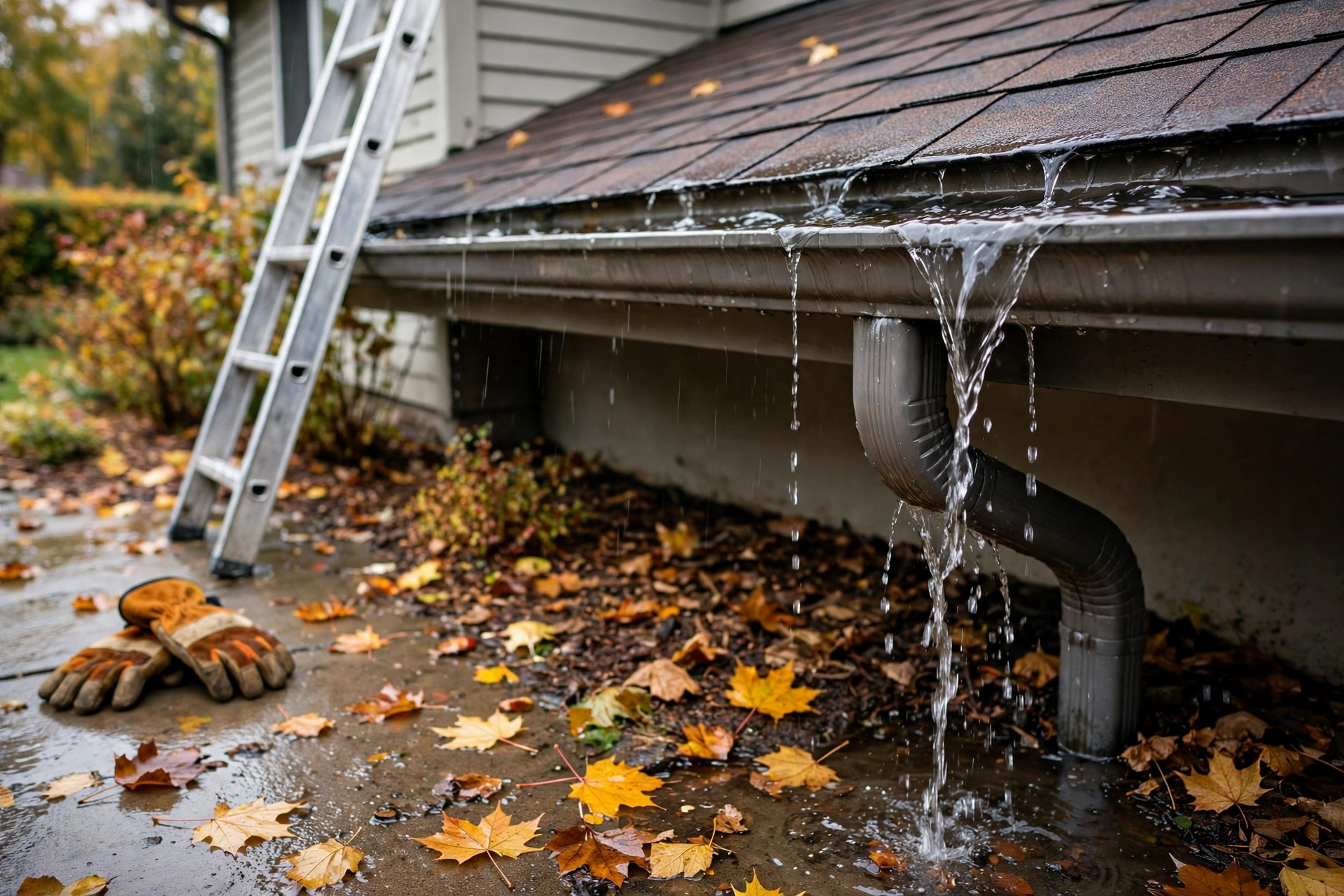
A schedule built only on seasons will miss the damage that storms do between cleans. After any heavy storm, walk the property and look at the ground beneath the downspouts. Water should exit cleanly at the bottom and flow away from the house. If it pours over the gutter edge instead, something is blocked. If a downspout has pulled away from the wall, high wind has worked a bracket loose.
The check takes ten minutes and needs no ladder. Look for granules or debris washed out of the downspout, which show that the roof shed material during the storm. Look for new damp patches on the siding below the gutter line. Either sign means the system needs a clean before the next storm, not at the next scheduled date.
Which Parts of the System Deserve a Closer Look Each Year
Most gutter problems do not announce themselves. The visible trough can look clear while the downspout, the part doing the actual work, is packed at an elbow. A proper clean is not just scooping leaves: it means clearing the full run, flushing every downspout, and noting damage like loose hangers, sagging sections, and corroded seams while you are up there.
| Part of the system | What to check | How often | Sign it needs work |
|---|---|---|---|
| Gutter trough | Debris, slope, sagging | Every clean | Standing water after rain |
| Downspouts and elbows | Blockages, secure fixings | Every clean | Overflow at the gutter edge |
| Hangers and brackets | Tightness, spacing | Yearly | Gutter pulling away from fascia |
| Seams and end caps | Leaks, corrosion | Yearly | Drips or rust streaks |
| Splash blocks and drains | Position, clear flow | Every clean | Water pooling near the foundation |
Keep a short written record of what you find each year. A seam that weeps a little this year and a little more next year is a seam that will fail in the third year, and the record is what tells you to replace it before it does. The log turns a maintenance schedule into a maintenance history, and the history is what makes the schedule smarter every year.
Gutter Guards, Downspout Screens, and Other Helpers
Gutter guards reduce the need for frequent cleaning, but they do not make gutters maintenance-free. Guards keep out large leaves while letting fine debris, pine needles, and shingle grit through, and that fine material still needs clearing once a year. A guard that is never inspected can hide a clog underneath it for years, which is worse than no guard at all.
Downspout screens are a cheaper helper with a clearer benefit: a small mesh basket at the top of the downspout catches debris before it can pack into the elbow, and it lifts out for cleaning in seconds. For homes with heavy tree cover, a combination of guards on the trough and screens on the downspouts, plus an annual inspection, is the most reliable setup.
Keeping a Written Record of Every Clean and Repair
A written record is what turns a maintenance schedule into a maintenance history. Note the date of each clean, what was found, and what was fixed: a seam that wept a little, a hanger that needed tightening, a downspout that ran slow. The note takes a minute, and it is what tells you next year whether a small problem is stable or growing.
Keep the record with the house documents, not in a phone that gets replaced. A simple notebook or a single sheet in a folder is enough. When a contractor arrives, the record shows them the history of the system in minutes, and they can price the work accurately instead of spending the first hour finding the problems. A home with a written drainage history sells better too, because the buyer can see the roof has been managed, not ignored.
Photographs help even more than words. Take a photo of the gutters from the ground after each clean, and a photo of any damage you find. A photo of a seam that looked fine last year and weeps this year is the clearest possible evidence that it needs replacing. The record does not need to be elaborate. It only needs to exist, and to be kept in the same place every year.
Roof Drainage Maintenance Schedule FAQs: Frequency, Storms, and Guards
How often should I clean my gutters?
Most homes need cleaning twice a year, once in late spring after pollen and seed pods finish falling, and once in late fall after the leaves have dropped. Heavy tree coverage, pine trees nearby, or a storm-prone region pushes that to three or four times a year. A home with no nearby trees in a dry climate may genuinely be fine with one annual clean.
Do gutter guards mean I never have to clean?
No. Gutter guards reduce how often you need to clean, but they do not remove the need. Fine debris, pine needles, and shingle grit still get through, and a guard can hide a clog underneath for years. Plan on an annual inspection and surface clearing even with guards fitted, and check the downspouts every time.
What should I do after a big storm?
Walk the property and check the ground beneath the downspouts. Water should exit cleanly and flow away from the house. If it pours over the gutter edge, something is blocked. Check for granules washed out of the downspout and for new damp patches on the siding. Clear any blockage before the next storm rather than waiting for the next scheduled clean.
Why is the autumn clean more important than the spring clean?
Because a clogged gutter that holds water into winter will freeze, expand, and pull away from the fascia, and can cause ice dams that force water back under the shingles. Completing the autumn clean before the first freeze gives the gutters the best chance of handling winter. The spring clean matters too, but it rarely prevents the kind of damage a frozen gutter causes.
How do I know if my downspout is blocked if the gutter looks clear?
Flush it with a hose. A proper clean means clearing the full run and flushing every downspout to confirm water actually exits at the bottom. The visible trough can look clear while the downspout is packed at an elbow. If water backs up or drains slowly, the blockage is in the downspout, and a plumber’s snake or a pressure flush will usually clear it.
Final Thoughts: A Schedule That Follows the Rain
A roof drainage maintenance schedule is not a chore list. It is a map of the year drawn from local facts: when the rain falls, when the trees drop, and when the frost comes. Twice a year for most homes, more often under heavy trees, and always a check after a big storm. That is the whole system, and it is enough to keep the gutters working for decades.
Start by writing the dates down: the spring pass in late May or early June, the autumn clean before the first freeze, and a ten-minute walk after every heavy storm. Keep a log of what you find. Within a year the schedule will fit your roof exactly, and the roof will stop surprising you.